
 |
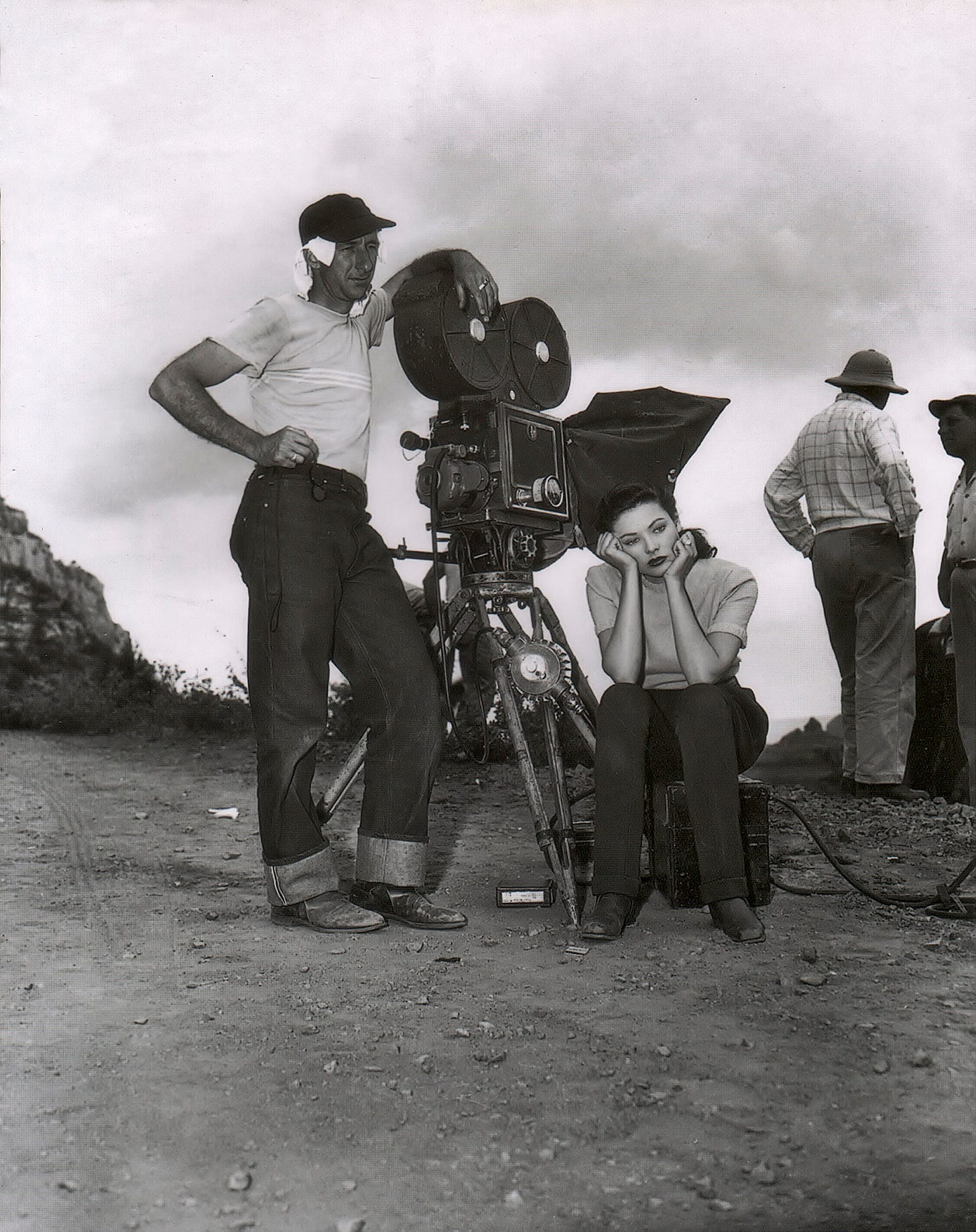
| Gene Tierney on the set of Leave Her to Heaven |
Introduction written for the 2018 John M. Stahl retrospective I curated in Bologna. — EK
And yet, across 43 films (a quarter of them sadly lost), Stahl shows that the search for love can bring healing, transformation, even transcendence. The turbulent and tender world he depicts has at its centre women, often working together and living alone. Active participants in a society undergoing change, they are portrayed with a rare sense of ease by some of the most glamorous screen icons. According to Gene Tierney, Stahl was “for bringing out the best in an actress”.
The Baku-born filmmaker treats the familiar themes of so-called “women’s pictures” with striking fluency and directness, favouring a certain bareness and modernity in both feeling and style. “In a motion picture of this type,” Stahl said of his directorial method, “emotion takes the place of action.”
Stahl began his career as an actor. He directed his first motion picture in 1914, followed by some 20 silent films. Between 1927 and 1930, while co-chairing the Tiffany-Stahl company, he produced more than 40 films – one of which, Clothes Make the Woman (Tom Terriss, 1928), offers a rare glimpse into the studio’s vibrant atmosphere. In the sound era, Stahl spent a decade at Universal Pictures, making several of his masterpieces, including Back Street and Only Yesterday. He then freelanced at Metro and Columbia before settling at 20th Century Fox, where he remained until his death.
For years, Stahl was best known indirectly, through two films remade by Douglas Sirk, remaining little more than a footnote in film history. In 2018, that history will be updated. In collaboration with the Pordenone Silent Film Festival, Il Cinema Ritrovato revisits the work of this master of melodrama, one of American cinema’s unsung auteurs. The Woman Under Oath (1919) will be screened in Bologna as a warm-up to a larger retrospective in Pordenone, which will include the majority of Stahl’s surviving silent films.
The festival in Pordenone will also see the launch of a book of critical essays, The Call of the Heart (edited by Bruce Babington and Charles Barr). Some of the book’s contributors have provided insightful notes on specific films for this programme, complementing their essays in the book, for which I give them my thanks. This selection of films is full of characters following the call of their hearts, no matter the price. In Stahl’s cinema, however, what is lost can be as invigorating as what is gained.

No comments:
Post a Comment