
Eight Girls in a Boat
Final part of my recommendations from Il Cinema Ritrovato 2026. — EK
31
Tol'able David
Dir: Henry King | USA, 1921
We dedicated a retrospective to Henry King’s sound films in 2019, and this is the perfect opportunity to catch up with what both King and his admirers regarded as his first true masterwork. The film bears touches of autobiography in its depiction of the pre-industrial rural milieu from which King himself emerged. It tells the story of a shy country youth who is branded a coward but ultimately proves his courage. To be screened in 35mm.
32
Kirsa Nicholina
Dir: Gunvor Nelson | USA, 1969
+
Le Monde du nouveau-né
Dir: Éric Duvivier | France, 1964
Two experimental films linked by their connection to the high priest of experimental cinema, Stan Brakhage. Made a decade after Brakhage’s Window Water Baby Moving, Gunvor Nelson’s Kirsa Nicholina offers its own take on the “birth film,” documenting the arrival of a child into the world. In contrast, Roman Duvivier’s Le Monde du nouveau-né presents a subjective account of infancy itself, tracing the experience of a child from the womb to its first steps.
33
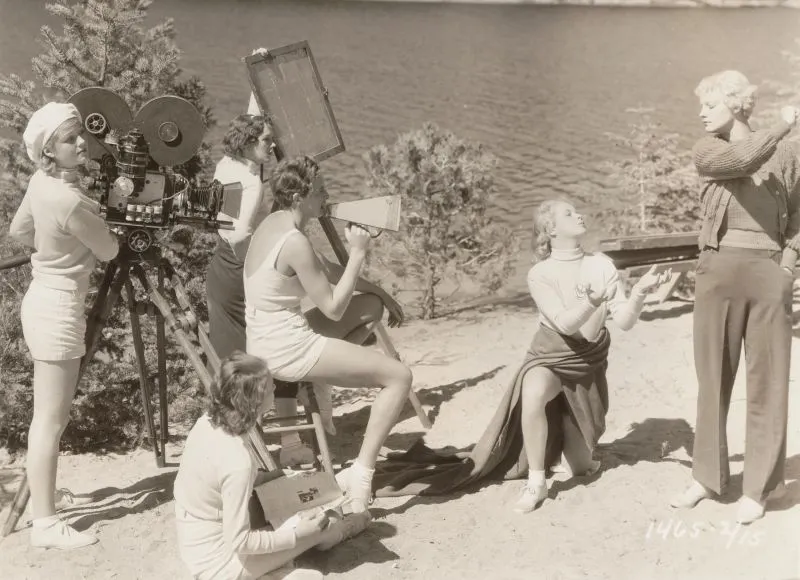
Eight Girls in a Boat
Dir: Richard Wallace | USA, 1934
America's answer to Mädchen in Uniform (1931) was one of my major discoveries of the year. Beautifully restored photochemically by the UCLA Film & TV Archive, the film shares some affinities with Cradle Song (Mitchell Leisen, also screening this year) in that it is set in an all-female environment – here, a boarding school. Yet it is unmistakably a pre-Code film in its daring suggestions of full nudity (through silhouette shots), its shower sequences, unwanted pregnancy, abundant images of scantily dressed girls, and its hints of lesbian desire. Visually, it is among the most astonishing films of the 1930s showing at this year’s festival.
34
La città si difende
Dir: Pietro Germi | Italy 1951
Written by Fellini and Comencini, directed by Germi, and starring Gina Lollobrigida, this Italian film boasts a dream team. Its story of a stadium heist bears a faint resemblance to Kubrick’s The Killing (1956), though it arrives at its thrills in a distinctly Italian register.
35
Oatsurae Koshi Jirokichi [Jirokichi the Rat]
Dir: Daisuke Itō | Japan, 1931
As the only one of Ito's silent films to survive in a more or less complete print, Jirokichi the Rat is our sole opportunity to experience the director’s early achievement in uncompromised form. In this flamboyant and fast-paced yet humanly moving masterpiece of the Japanese period film, his flair, energy and stylistic imagination is fully visible. This will feature our first benshi screening ever.
36
Shinel [The Overcoat]
Dir: Grigori Kozintsev, Leonid Trauberg | USSR, 1926
A new restoration of a film by my favourite Soviet director, Grigori Kozintsev – cinema’s finest interpreter of Shakespeare. Based on Gogol’s celebrated stories, the film reveals influences that extend well beyond the still nascent Soviet avant-garde. Its ideal companion at Il Cinema Ritrovato is Voices from the Chorus, the new essay film by Ian Christie and Roland Denning, which helps illuminate the cultural and historical context from which the film emerged.
37
Princesse Tam-Tam
Dir: Edmond T. Gréville | France, 1935
By the greatly idiosyncratic and still subject-to-further-research Gréville, this is a Pygmalion-like tale, though considerably more complex than most familiar variations on the theme. Part of its fascination lies in the way it exploits stereotypes and situations born of colonial ambition, racial exoticism, and Parisian high society (it is no surprise that its title was later appropriated by a French lingerie brand). Despite sounding like its not your sort of movie, the presence of Josephine Baker – dancer, future Resistance member, and civil-rights activist – elevates it into something that should not be missed.
38
Gerô no kubi
Dir: Daisuke Itō | Japan, 1955
Compensation for the tragic loss of most of Ito's early work comes in the form of this postwar masterpiece, a virtual remake of one of his silent classics. Sustaining the anti-feudal vision visible in his silent films, Ito offers a trenchant social critique in this reworking of a story famously described by critic Fuyuhiko Kitagawa as “the tale of a dog bitten by its own master.”
39
The Long Memory
Dir: Robert Hamer | UK, 1953
Hamer’s masterful, sombre tone and his images of disenchantment and alienation are an homage to French poetic realist cinema, especially the work of Marcel Carné. The film’s plot – shaped by the traumas of the past – places it in the lineage of American film noir, as a kind of close relative. However, it is ultimately closer to an arthouse film than to a crime thriller, even if it is driven by John Mills’ relentless determination to track down those whose lies led to his wrongful imprisonment for twelve long years.
40
Darling, How Could You!
Dir: Mitchell Leisen | USA, 1951
One of Leisen’s most brilliantly conceptual films – a comedy of manners in which Leisen asks what would happen if the parent–child relationship were reset and one had to get to know one’s family from scratch at a later stage in life. The result is delicately embarrassing, hilarious, and touching – sometimes all three at once.

No comments:
Post a Comment