
 |
| The Seed of the Sacred Fig |
“I am very close to nature. I spend a great deal of time in the mountains. If Iran becomes a free country one day, I’d love to make wildlife documentaries,” says Mohammad Rasoulof who fled the country by crossing the mountainous terrain of western Iran on foot with nothing — not even a passport (previously confiscated) — to arrive in Europe and add the final touches to The Seed of the Sacred Fig, which premiered in Cannes last May. The man who could have been the David Attenborough of Iran is, until further notice, one of the foremost clandestine filmmakers in that country.
“For now, the freedom and dignity of man are my top priorities. I keep asking myself why a system allows itself to do this to us.”
Rasoulof’s frequent provocation of the Iranian regime has led to multiple prison sentences, passport and asset confiscations, yet the dissident filmmaker has created some of his more formally audacious work during these years of relentless turmoil and harassment. We met in London while he was in transit from Ukraine (where he had served as the head of jury at Kyiv’s Molodist film festival) to the US, where, the day before, Trump had been elected to a second term as President. The last time I spoke to him, he told me that to avoid being recognized by the regime’s agents he wore heavier makeup on set than the actors. Now, he has come up with a new solution:
“Because there was a possibility of the regime raiding the set, I made this film from afar. Most of the time, I wasn’t physically present on set, or I was a few kilometres away. Sometimes I was 100 or 200 meters away. For the car scenes, I was in the back of a car driving behind the production cars. The idea was, ‘I’m not there.’ I had two assistants who were in constant contact with me.”
The Seed of the Sacred Fig is entirely based on the events surrounding the September–December 2022 uprising of Iranian women — Women/Life/Freedom — that took Iran by storm and sent thousands onto the streets of Berlin, Paris, London and many other cities around the world in solidarity. The film incorporates actual footage shot by citizens during the protests and makes dramatic use of other facts, such as the police using bucket shots and firing them directly at the faces and genitals of protesters. The hacking of the names and addresses of the Islamic regime’s oppressors is another factual detail that Rasoulof has woven into his story.
“I said to myself, ‘You are telling the story of a family trapped in their apartment. They are afraid to go outside. How are you going to show what is happening outside?’ Let’s say, hypothetically, I had permission to shoot this film, and a street was at my disposal. Was I going to reenact events when the power of reality in social media footage is so strong? So I chose the most iconic images. I didn’t use unseen footage and sound bites. Instead, I said, ‘Let’s show what has been seen and is familiar to everybody.’”
Rasoulof has been preoccupied with the inhumanity of the justice system since his early days as a documentary filmmaker but here his washed out images and the suffocating world of the family take on a sharper edge. There is no ambiguity in the film’s intentions. Unlike the stark bleakness of his previous films, The Seed of the Sacred Fig portrays ordinary people rising up against oppression in an act of resistance. Against the images of the State’s heroes and martyrs, vulgarized as paperboard cutouts, stand women who carry the weight of the story once the film shifts its focus from the father of the family, Iman — meaning “faith.” Iman is promoted to the position of interrogator in the judiciary. His hope of acquiring a larger apartment is shattered when the women’s uprising and the loss of his gun result in an emotionally violent confrontation with his two rebellious daughters.
“We are talking about a specific type of family in which submissiveness has been inherent. We see this in the photograph of the father as a young man on the wall, taken at Imam Reza’s shrine, where he has placed his hand on his chest — a gesture of total submission to the religious ideal. The same submissiveness has influenced politics and the military, hence the cutouts of martyrs and deceased religious figures. Submissiveness and conformity are the main themes of the film. I realized that insecurity can turn people into submissive figures. The father wants to give this attitude an air of sanctity and expects the family to follow suit.”
When Sana, the younger daughter, escapes from her father in a scene reminiscent of The Shining‘s family terror, she finds refuge in a shed where religious props for the annual Shia mourning ritual are stored. In this space of presumed veneration, she discovers tapes of pioneering female singers predating the 1979 revolution — voices now banned. These and the removal of the mandatory hijab are some of the taboos that Rasoulof breaks. Adopting a more head-on approach, the film strives to move beyond the mode of representation that Iranian cinema has excelled in since the 1960s: allegory.
“I decided to put away allegorical and metaphorical language because I felt it was a form of self-censorship. I decided to be myself. What matters to a dictatorship is that you aren’t yourself. Stripping someone of their sense of self is what happens in that system. The aesthetics I had used over the years were what I call the ‘aesthetics of tyranny.’ I decided to reject them.”
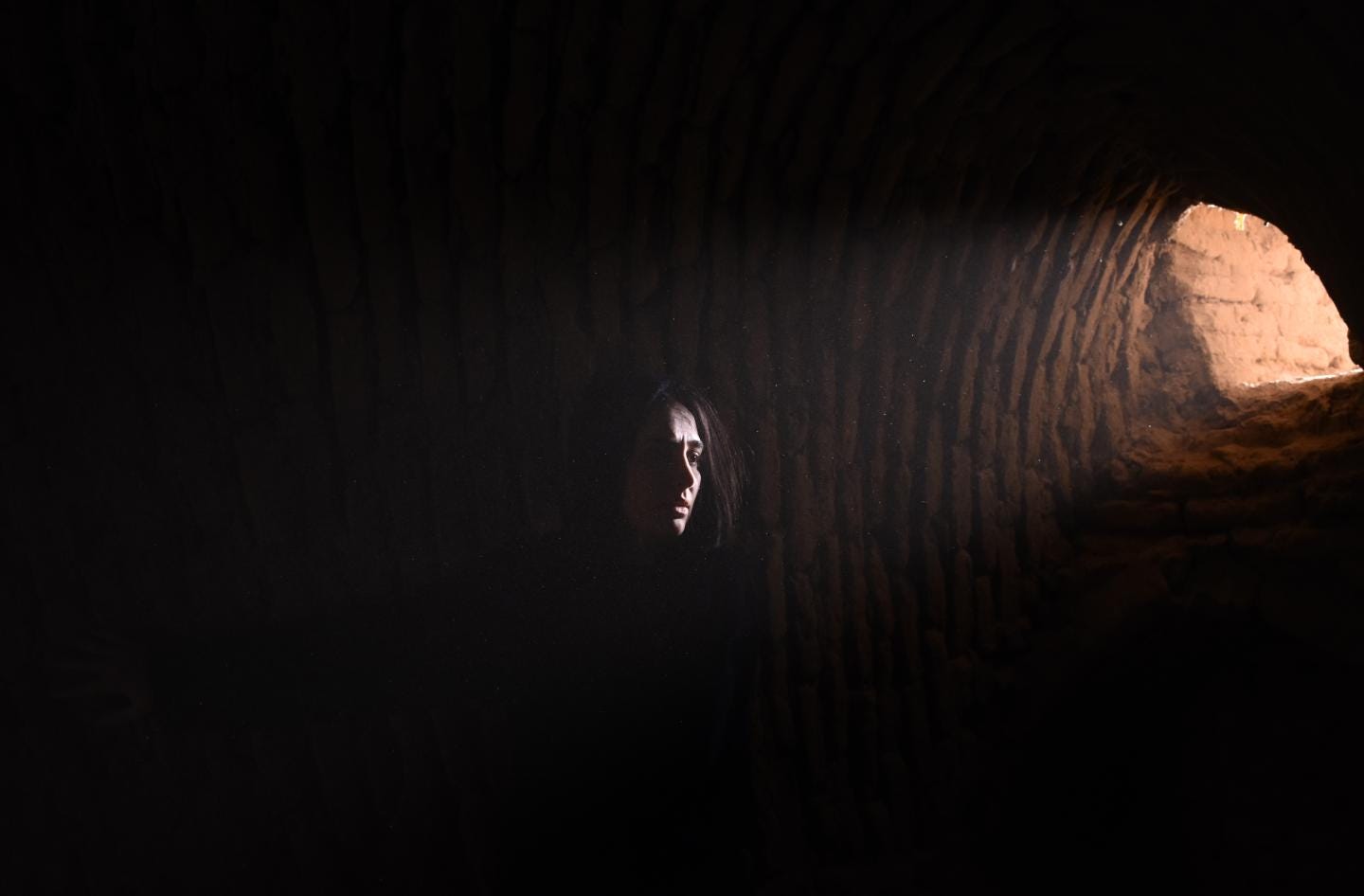
Despite its directness, the film still employs some allegorical imagery to enrich the narrative effectively. This kind of symbolism is apparent, among other scenes, in the “ancient ruin” (Iran?) where the final act unfolds. The ruin, a significant symbol in Persian poetry and cinema — particularly in the work of Rasoulof’s fellow Shirazi director and godfather of the Iranian New Wave, Ebrahim Golestan — also serves a practical purpose. The ingenious use of space helps reframe the story in line with the clandestine nature of the shoot, allowing the filmmakers to stay out of sight of the regime’s watchful eyes.
“I said, allegory doesn’t serve the same function, but if you can use it creatively, go for it. Let me confess something: I never thought I was going to finish this film, so I said, ‘Be playful, do whatever you like, throw away your knowledge.’ I just wanted to get rid of everything I knew.”
Alongside this subtle symbolism, several of Rasoulof’s recurring motifs, water and washing as an act of purification, resurface.
“That’s so me! In the worst situations, I feel that going for a swim would change my mood. I was also raised in a crowded family, and often the only place to have some privacy was in the bathroom!”
Until Rasoulof, very few Iranian films explored political disillusionment through the lens of family and the toll it takes on those relationships, with the devastating Dead-End (1977) by the now-exiled Parviz Sayyad being a rare exception.
“Family is the most basic social unit. I focus on things happening around me, including my own family. I come from a family of teachers — my parents and older siblings are all teachers; I am the only one in the family with a different vocation. In our family, especially with my mother, the focus was usually on solving people’s problems. Students used to come to our house for extra lessons. In the film, the wife/mother character, who tries to keep the family balanced and is always on a tightrope, is modelled on my mum and my aunt — people who are very selfless.”
The Seed was shot clandestinely but it is not a militant film – it is a thriller, with the conditions of its production mirroring the thriller. And Rasoulof owes more to the cinema of the 1970s — both Iranian and American — than to any other period in film history. Once the master of surveillance feels he himself is being watched, the paranoia that turns the house upside down evokes The Conversation. Then there’s Robert Altman’s Three Women, with its themes of female bonding and burying the male figure. Though these are likely to be unconscious influences, Rasoulof is aware of how cinephilia has shaped his life. He tells me even the guards at the notorious Evin prison turned out to be enamoured with cinema:
“During serving my prison term, I was hospitalized twice. (By the way, I was taken there in the same green vans you see in the film, which were used for both prison and school transport; the driver was always in a rush to drop off the prisoners and go pick up the children.) In the hospital, two soldiers guarded me. They were kindly and out of respect for a filmmaker didn’t lock my handcuffs. They were very curious about cinema, asking questions all the time. They brought a bootleg copy of my previous banned film Evil Doesn’t Exist and played it every single day that I was in the hospital. They were fascinated by how they were represented in the film since the film shows prison guards. They shared with me their wish to leave Iran and start a new life.”
He tells his prison stories with a dark humour, a quality surprisingly absent in his films that remain sombre and introspective.
“Jafar [Panahi] and I were taken to prison’s cultural office. They said ‘You should make a movie for us in prison’. Jafar and I were wondering ‘Are we in a madhouse?’ We came up with the excuse that we don’t have a cameraman. The officer immediately replied, ‘Who do you want? We can arrest any cameraman you like!’”
When I asked him what keeps this ramshackle system — built on mendacity, cardboard heroes, and deep disillusionment — propped up, he replied, without any hesitation: “Money. Brutality. Sanctification.” In doing so, he unwittingly explained what is causing the world to fall apart before our eyes.

No comments:
Post a Comment