
On Warner’s stereoscopic systems in the 1950s, and some new 3-D restorations premiered at Il Cinema Ritrovato 2026. – EK
In the 1950s 3-D arrived with the loud bang announcing an immersive cinema — Natural Vision, Paravision, Metrovision, and other “visions” — that would supposedly end “flat” filmmaking, but went out with the faint hiss of a flat tire. It kept being revived, except that each time nobody could sustain it for more than a couple of years, the last revival coming in the early 2010s. In the meantime, while it seems destined never to become a true cinematic mainstay, the classics of 3-D cinema continue to enjoy a cult following whenever they can be screened in their original dual-35mm format or in digitally reproduced 3-D DCPs.
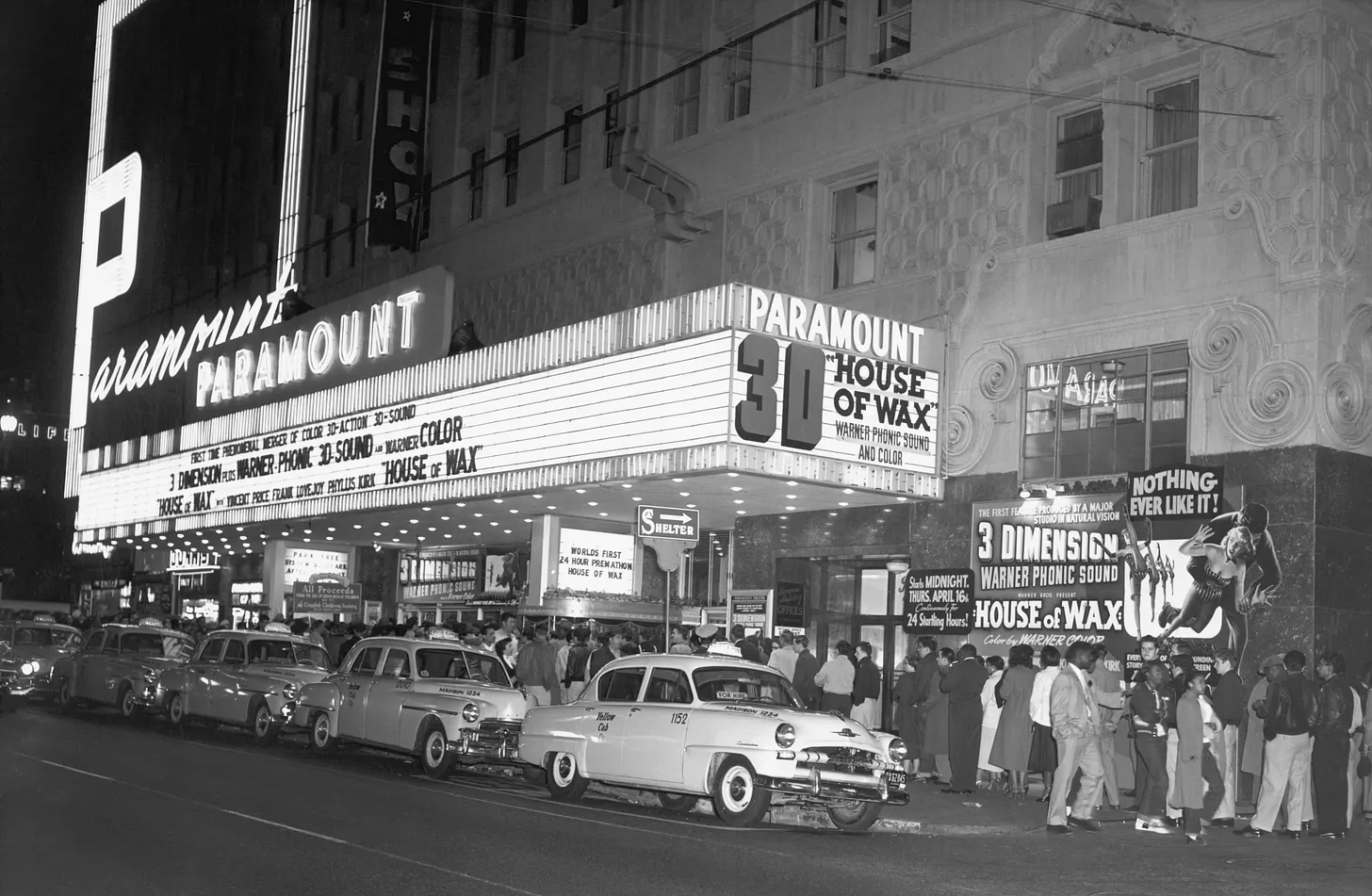
This programme (below) looks at some of the lesser-remembered 3-D output of Warner Bros that produced the most universally popular early 3-D films, House of Wax (1953). Warner soon developed its own stereoscopic system, WarnerVision – engineered by Albert W. Tondreau, Mike McGreal, and Fred Gage – with which the terrific western Hondo (1953) was shot. (I was lucky enough to see a double-projector screening of this at the Film on Film Festival at BFI Southbank, and I must say I prefer it to digital reproductions of the 3-D system.)
Warner was also responsible for producing some of the more artistic and less gimmicky 3-D films, such as Hitchcock’s Dial M for Murder, released in 1954, just as the format was rapidly falling out of fashion by the end of the year. The two main directors represented here, Andre De Toth and Roy Del Ruth, not only have their names rhyme, but also their cinematic sensibility: unabashed shockers displaying a keen understanding of sets and movement.
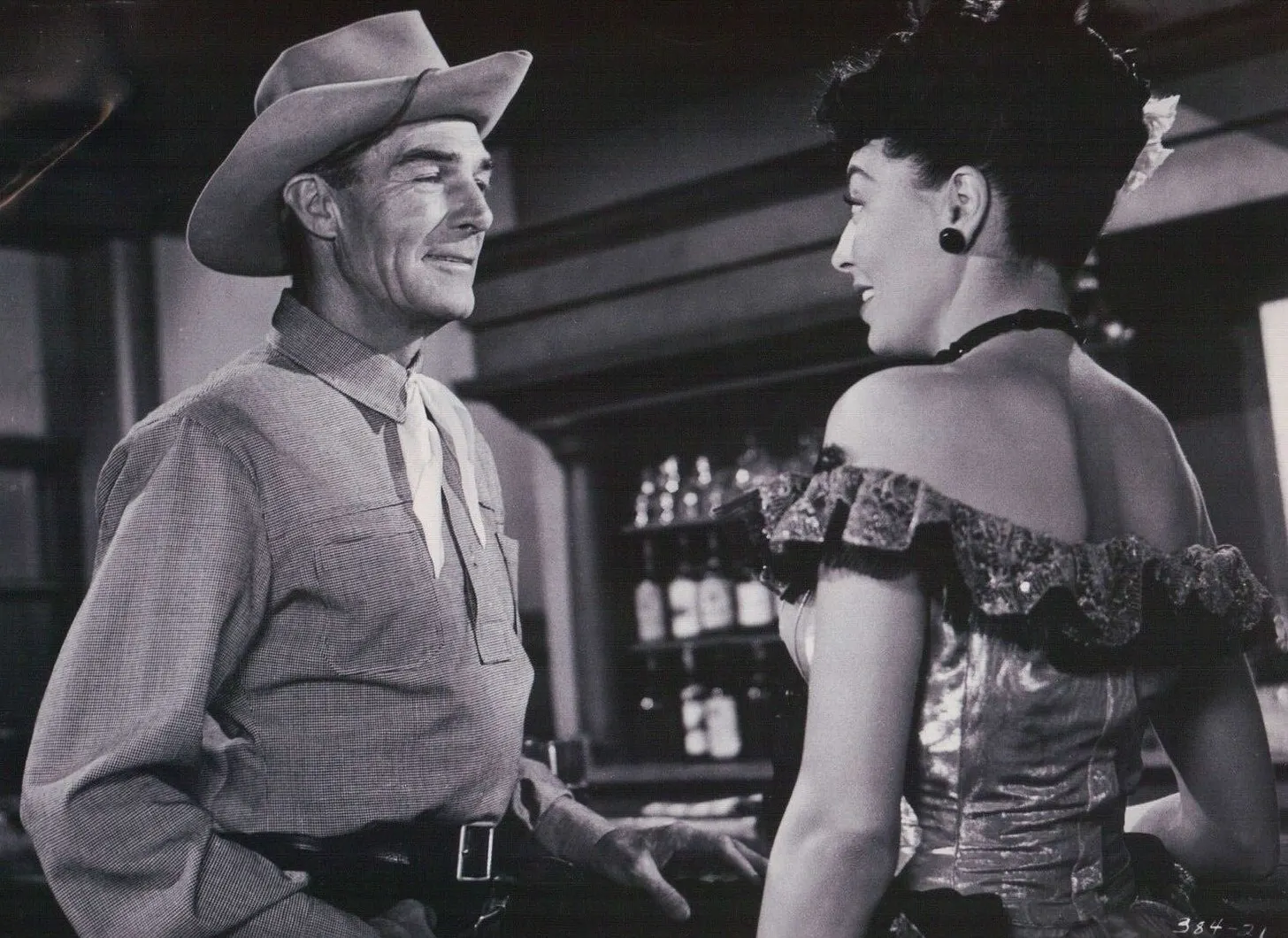
The Bounty Hunter
Bounty hunter Jim Kipp (Randolph Scott), pursuing three robbers and murderers, upsets the decorum of a town steeped in gentility, where many of its respected citizens harbour dirty secrets.
Andre de Toth’s involvement with westerns resulted in eleven titles across various studios, mostly Warner and Columbia. Six of them featured Randolph Scott (The Bounty Hunter being the last), who never quite managed to recapture the austere magic he achieved with director Budd Boetticher, partly because these films were too low-budget and their scripts seldom rose above variations on clichéd plots. The production itself was regarded so poorly that the film’s opening sequence was lifted from another De Toth western for Warner, Carson City (1952), with all the original shots recycled except for the reaction shots of the man at whom Scott points his gun.
The film was shot in 3-D but seen mostly – or, according to some accounts, exclusively – in standard format. Of Warner’s 3-D productions, this is also among the least adventurous in exploring the possibilities of the extra dimension, save for a shot of a hat being blasted off a villain’s head and flying directly into the camera. Hardly surprising, perhaps, given that the man directing the film had only one eye.
As a bounty hunter, Scott remains too bound to the notion of the gentleman gunfighter, with his asexual, church-going demeanour. The film’s real strength, however, lies in the fact that, almost until the end, Scott does not kill any of his presumed targets: they are eliminated by other fearful individuals attempting to conceal the identity of the true criminals. This process of self-elimination is what makes The Bounty Hunter such a fascinating reflection of Hollywood’s anxieties during the blacklist era, alluding to the McCarthyite vision of a fearful town in which everyone has something on his or her conscience.
Phantom of the Rue Morgue
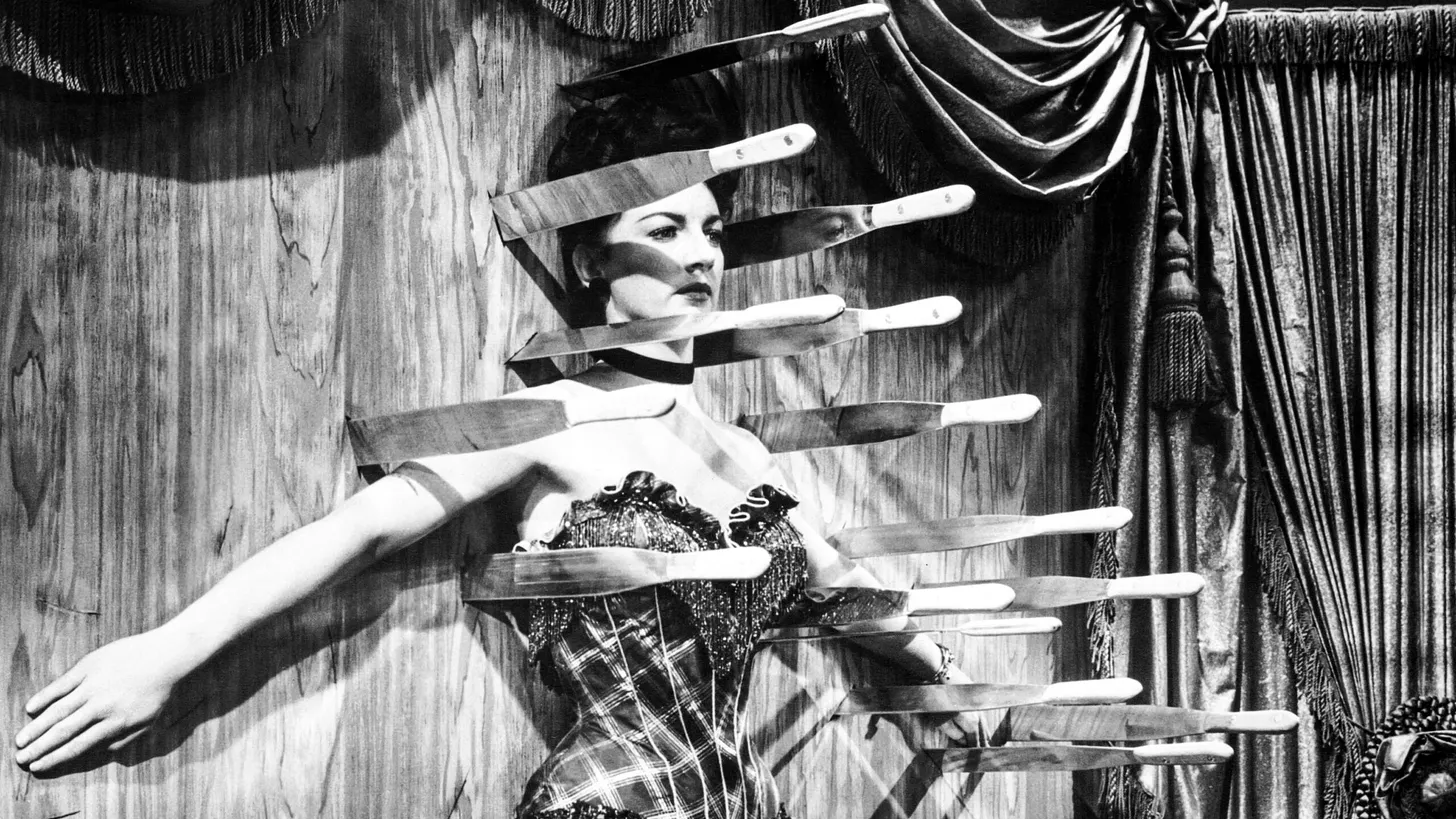
Warner was keen to repeat the success of its biggest 3-D hit, House of Wax, with another colour horror film. Of the two attractions, however, colour somehow managed to override 3-D. With its flared-up, garish, erotic tones, the brutal serial killer of the Rue Morgue turns scenes of grisly crime into a kind of abstract expressionist painting made from body parts, splattered oil paint, and shattered glass.
This belongs to the more familiar vein of 3-D filmmaking, in which objects are hurled at the lens at regular intervals: gendarmes – reliving the thrills of early cinema in The Great Train Robbery – fire directly at the audience; a knife-thrower does the same; a trapeze artist plunges onto the safety net beneath him, where the camera awaits his downfall. The eyes – we – are under constant threat once the third dimension is unleashed. The weight is always on the eye, rarely on the brain.
Based on Edgar Allan Poe’s 1841 short story about a series of gruesome murders whose motive and method defy logic, the film retains the Paris setting but transposes the material into a post-Freudian world. “These days everything is Freud or is nothing,” complains a zoologist played by Karl Malden. Thus Phantom of the Rue Morgue populates itself with an array of rejected side characters, all living with suppressed libidoes and the tightly locked secret rooms of their desires.
The serial killer attacks women of a certain beauty and bearing. The scantily dressed models and performers have what little they wear violently torn away by the killer, and every murder scene carries a disturbingly sexually perverse undertone. After all, the “beast” is simply the human form reduced to instinct, and of all instincts it is lust that rules.
Roy Del Ruth shows very little interest in directing actors and instead relies on the wood-and-paper-mâché sets – featuring some of the dreamiest Paris rooftops since Lazare Meerson – fully responsive to the film’s acrobatic demands. It is a fantastically brazen and lewd film, all the more surprising coming from a director whose heyday belonged to the 1930s.
Lumber Jack-Rabbit
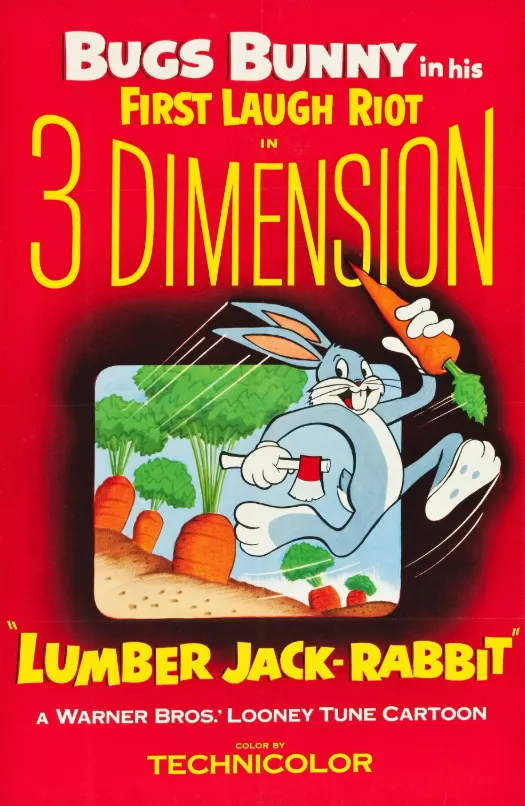
The first 3-D cartoon by Warner featured Bugs Bunny stumbling upon a carrot mine and setting up extraction facilities before realising he is in the land of giants, the territory of Paul Bunyan – the giant lumberjack – whose mountain-sized dog poses a serious problem. Paired with the Barbara Stanwyck 3-D feature The Moonlighter, this vegetarian short delivers its most outrageous moment before the story even begins, when the Warner Bros. logo pops out and then thrusts even farther forward to fill the entire theatre.

Your account of sets and movement makes this programme more useful than a list of stereoscopic formats. A companion exercise could map foreground, middle distance and background, then ask what a character’s crossing changes in our understanding of the scene. For an original storyboard planned with Seedance 2.5, I would stage a figure passing behind a foreground doorway before revealing what they are watching. Comparing that with a version that reveals the object first would give the timing of occlusion a clear dramatic question, even when working with flat boards.
ReplyDelete