
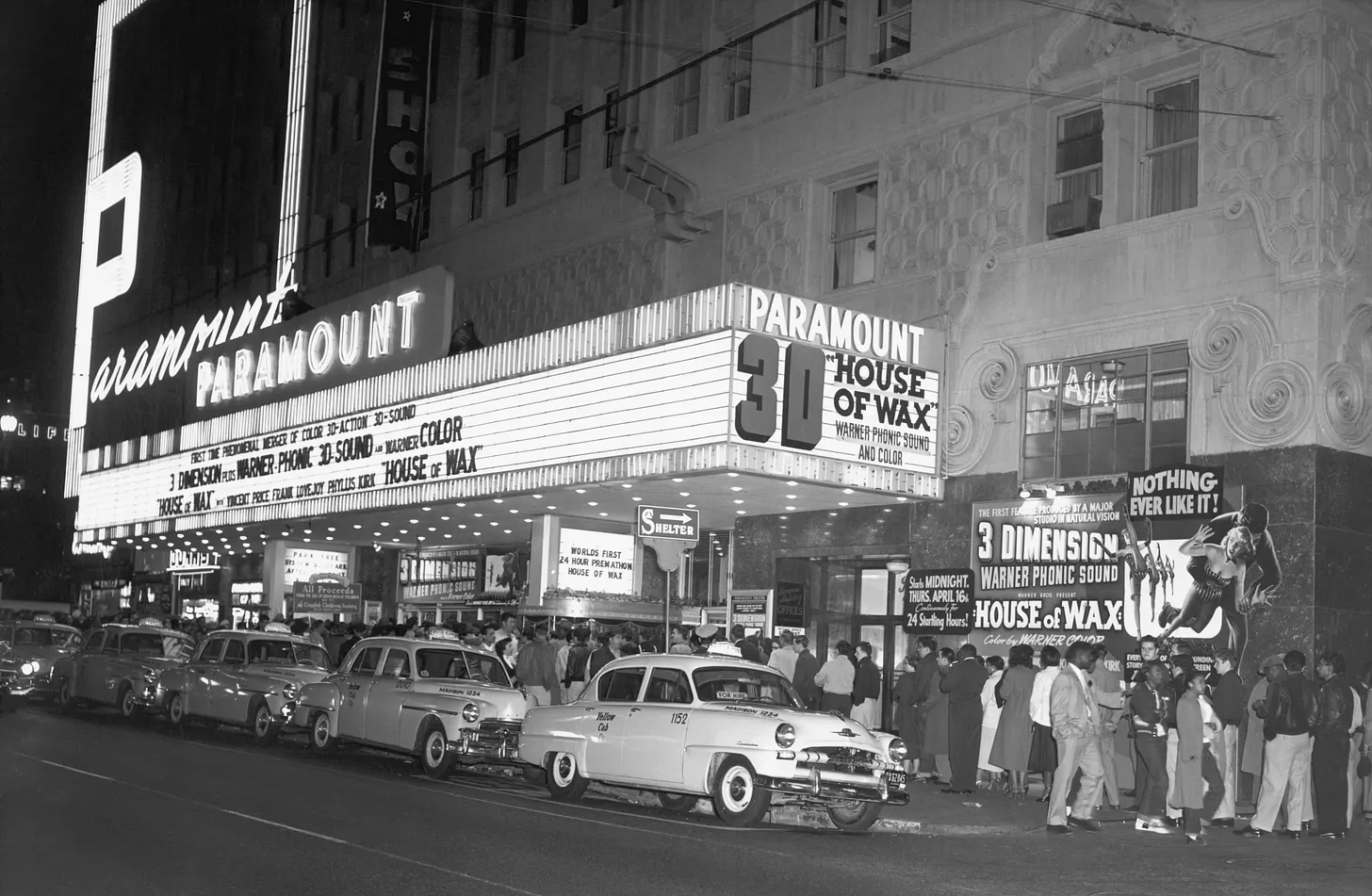
On Warner’s stereoscopic systems in the 1950s, and some new 3-D restorations premiered at Il Cinema Ritrovato 2026. – EK
In the 1950s 3-D arrived with the loud bang announcing an immersive cinema — Natural Vision, Paravision, Metrovision, and other “visions” — that would supposedly end “flat” filmmaking, but went out with the faint hiss of a flat tire. It kept being revived, except that each time nobody could sustain it for more than a couple of years, the last revival coming in the early 2010s. In the meantime, while it seems destined never to become a true cinematic mainstay, the classics of 3-D cinema continue to enjoy a cult following whenever they can be screened in their original dual-35mm format or in digitally reproduced 3-D DCPs.
This programme (below) looks at some of the lesser-remembered 3-D output of Warner Bros that produced the most universally popular early 3-D films, House of Wax (1953). Warner soon developed its own stereoscopic system, WarnerVision – engineered by Albert W. Tondreau, Mike McGreal, and Fred Gage – with which the terrific western Hondo (1953) was shot. (I was lucky enough to see a double-projector screening of this at the Film on Film Festival at BFI Southbank, and I must say I prefer it to digital reproductions of the 3-D system.)
Warner was also responsible for producing some of the more artistic and less gimmicky 3-D films, such as Hitchcock’s Dial M for Murder, released in 1954, just as the format was rapidly falling out of fashion by the end of the year. The two main directors represented here, Andre De Toth and Roy Del Ruth, not only have their names rhyme, but also their cinematic sensibility: unabashed shockers displaying a keen understanding of sets and movement.
