
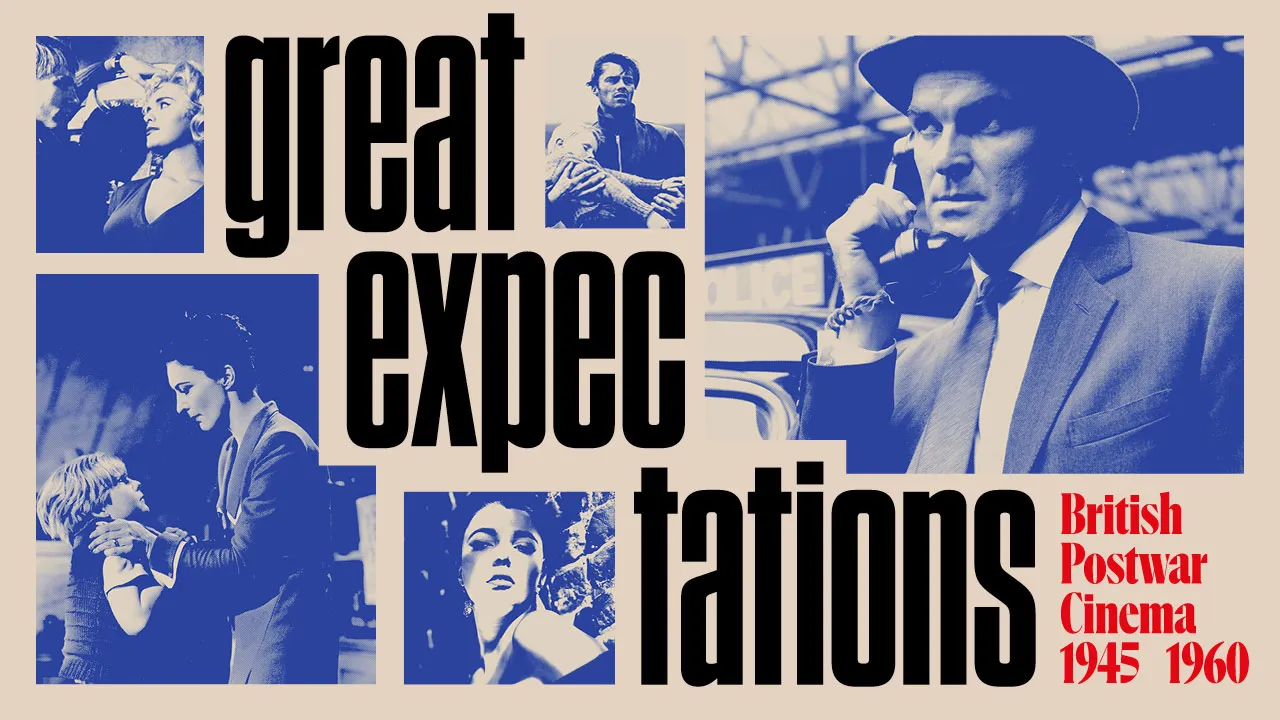
The Great Expectations season is underway at BFI Southbank. The Financial Times’ Henry K Miller has penned a fine piece about this smaller selection from a British postwar cinema retrospective of the same name, originally curated for the Locarno Film Festival (August 2025), where the full 45-film programme premiered. He asked me several questions before publishing his piece, and I reproduce my responses here to provide further clarity about the nature of the season and its origins. This was an email exchange.
Part of the rationale for the Locarno version was that you were presenting these films to an international audience. What have you done differently for the London rehang?
In London, it also serves as an introduction to the BFI National Archive, showcasing their 35mm prints. Having now learned the hard way how challenging it is to screen British films in 35mm – and that it will likely become increasingly difficult in the future – this moment should be cherished by Londoners.
What I have learned from this, however, is that the films one assumes “everyone” has seen are not necessarily as widely seen as one thinks. Today, there is a less visible line between national and international audiences, except when it comes to understanding cultural nuances and language. When it comes to exposure to the history of a national cinema, people’s knowledge – and their gaps in knowledge – can be remarkably similar.
The BFI programme doesn’t state the governing principles that appear in the book, i.e. no period films, no fantasy films, no kitchen sink. Were you tempted to relax them?
I’m sure it was mentioned somewhere in the press release, but that doesn’t really matter, because the BFI selection features only a quarter of the titles shown in Locarno, and emphasising what is not there doesn’t seem particularly important.
As for relaxing the selection criteria, no – we haven’t added any titles that were not shown in Locarno. That’s one key difference between a specialist film festival and a city cinematheque: in the former, you can feed the audience plenty of information, whereas in the latter you offer it in smaller doses. You don’t overwhelm, and you remain open and inviting to people who may not know much about the films.
There weren’t many colour films at Locarno, but here there are none – was that a rule or just how things shook out?
There was no rule. It just happened. The rare gem in Locarno was the VistaVision colour film Simon and Laura, but that was exhibited at the BFI Southbank recently, so there was little point in showing it again. For Locarno, I wanted more colour prints, but they are usually the ones more severely affected by the elements. So it is harder – not just in Britain, but in cinema in general – to show decent colour prints from that period. I wish I could show one of my favourite British colour films, A Letter for Wales. Alas, the BFI print was no longer screenable.
For a long time the idea of a ‘lost continent’ precisely consisting of certain period and fantasy films has held sway, counterposed against films in the ‘documentary realist tradition’, such as the kitchen-sink films. Do you see your project as an attempt to move on from this binary?
I took the middle ground: between fantasy and reality, between style and content, between social commitment and existential awakening; a foggy zone between the documentary movement and the cinema of emotional excess that emerges toward the end of the 1950s. The period I focus on, I personally prefer to both what came before and what came after – except for Hammer horror. I like that Jean-Paul Török argues that Hammer horror was the real “Free Cinema” of Britain.
The programme makes a claim for realism – ‘Britain as reflected in its postwar films’. In this light, do you think the kitchen-sink films constituted a genuine break?
On the contrary, the kitchen-sink films were the most self-conscious phase of this period of reflection – but perhaps too self-conscious, and their realism too square and well executed. It is a designed realism. The reason I excluded them was that I needed focus. Those films are far better seen outside Britain than, shall we say, Three Weird Sisters or the work of the brilliant Lance Comfort (whom I put forward in Locarno as one of the finest of his generation). I don’t do novels with my programme; I do short stories. I eliminate subplots and side characters and follow only one character. Here, I simply followed Timothy.

No comments:
Post a Comment