
 |
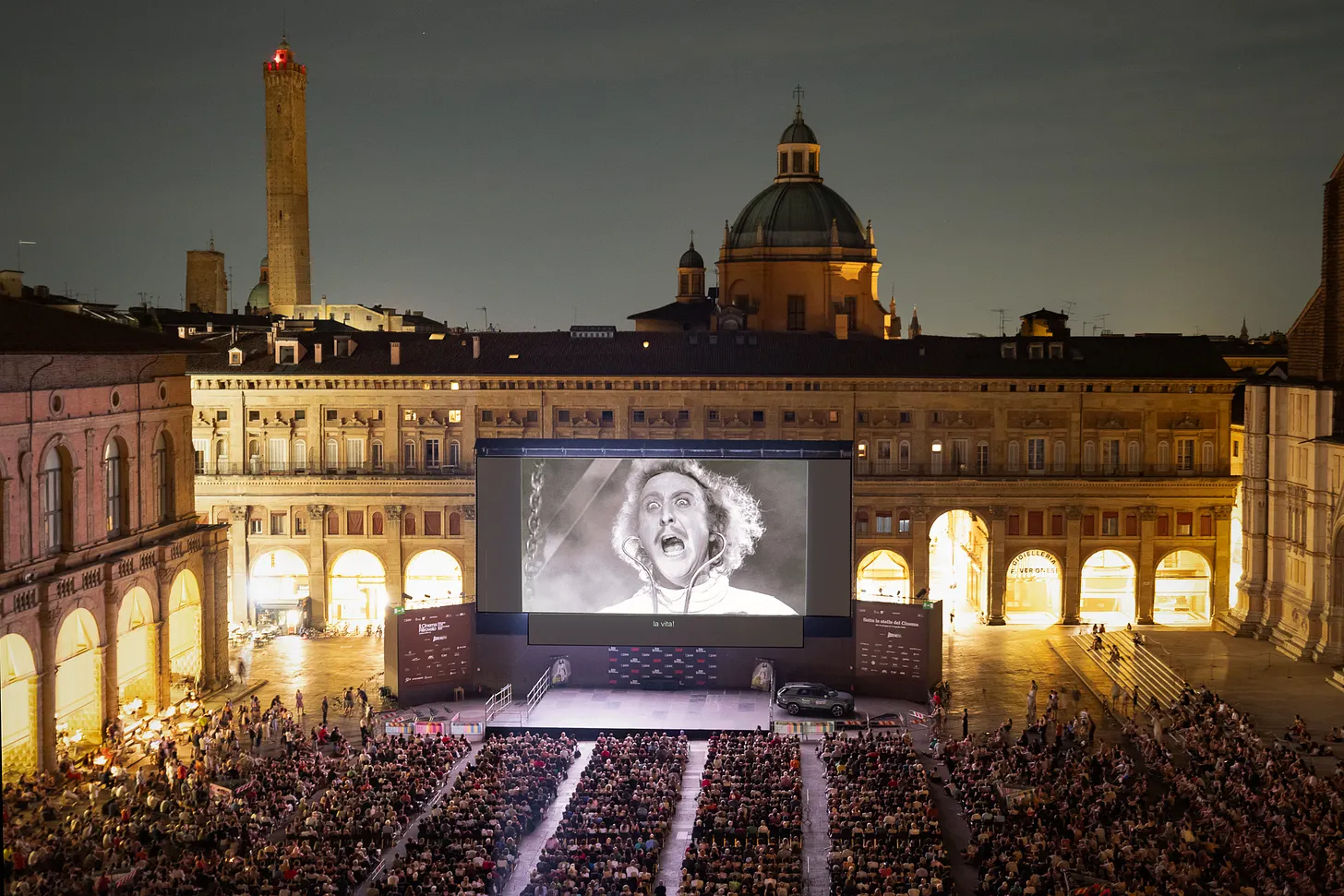
| Young Frankenstein turned 52; Mel Brookes turned 100; we turned 40. We're still the youngest. |
"If it's worth doing, it's worth overdoing," I once heard King Vidor say in a cameo appearance. This year in Bologna, we certainly took him at his word. Not only did we overdo it, but so did the generally inhospitable weather and the drifting audience navigating the scorched cityscape between the festival's nine venues. Even before receiving a single vote, I was certain that a programme of this scale would make any truly cohesive result impossible. I wasn't entirely wrong.
Il Cinema Ritrovato XL (I was told at least one person thought the "XL" was a gesture of self-congratulatory grandiosity; It means 40 in Roman numerals, the age of the festival) featured close to 500 films across multiple venues, with the Odeon added at the last minute for three days to ease the pressure on the other cinemas.
The screenings were attended by 145,000 people: 75,000 in the cinemas and a further 70,000 at the evening screenings in Piazza Maggiore.
Close to 180 attendees (out of more than 5,000 accredited guests) participated in this annual survey.
I would like to take this opportunity to thank everyone who attended—for their resilience, for their indefatigable journeys across oven-hot pavements, and for their willingness to transgress the canon.
Gods are dead. Movies are alive.
Antti Alanen (Finland)
Absolute favourite: Amma Ariyan (John Abraham, 1986)
Major discovery: The Sixteen-Millimeter Shrine (Mitchell Leisen, 1959)
Giaime Alonge (Italy)
Absolute Favourite: What Price Glory (Raoul Walsh, 1926)
Major Discovery: Albert Samama Chikli e la Section Photographique et Cinématographique de l’Armée.
Nurain Amin (Singapore)
Absolute favourite: Tinimbang Ka Ngunit Kulang [Weighted but Found Wanting] (Lino Brocka, 1974)
Major discovery: Menq [We] (Artavazd Peleshian, 1969)
Annouchka de Andrade (France)
Absolute favourite: Un Dessert pour Constance (Sarah Maldoror, 1981)
Major discoveries: Pasolini (Interview with Alberto Moravia) (1983) + New York, New York (Martin Scorsese, 1977)
Note: The New York, New York event in the Piazza Maggiore was very moving.
José Arroyo (UK)
Absolute favourite: Mudar de Vida (Paulo Rocha, 1966)
Major discovery: Tinimbang Ka Ngunit Kulang [Weighted but Found Wanting] (Lino Brocka, 1974)
Kaveh Askari (USA)
Absolute Favourite: The Dislocation of Amber (Hussein Shariffe, 1975)
Major Discovery: Ajantrik (Ritwik Ghatak, 1958)
Absolute Favourite: Sunrise: A Song of Two Humans (F.W. Murnau, 1927)
Note: Experiencing Sunrise in Piazza Maggiore with live accompaniment was extraordinary. Murnau’s fluid, liberated camera, expressionist imagery, and seamless fusion of realism and the dreamlike remain breathtaking. In an age dominated by speed and literalism, Sunrise reminds us of cinema’s unique ability to express emotional truth through movement, light, and metaphor rather than dialogue. It evokes a form of human connection, and a poetic surrealism that contemporary cinema too often neglects. The live score and the collective experience in Piazza Maggiore made its emotional and visual power feel as vital today as it must have in 1927.
Major Discovery: Dayere-ye Mina [The Cycle] (Dariush Mehrjui, 1974)
Agą Baranowska (UK)
Absolute Favourite: Now You Tell One (Charles R. Bowers & Harold L. Müller, 1926)
Major Discovery: Krynytsia dla sprahlych [A Well for the Thirsty] (Jurij Illjenko, 1965)
Jenny Lynde Barker (USA)
Absolute Favourite: Hold Back the Dawn (Mitchell Leisen)
Major Discovery: Kuroi Jūnin no Onna [Ten Dark Women] (Kon Ichikawa, 1961)
Cecilia Barrionuevo (Argentina/Spain)
Absolute Favourite: Dayere-ye Mina [The Cycle] (Dariush Mehrjui, 1974)
Major Discovery: Tinimbang Ka Ngunit Kulang [Weighted but Found Wanting] (Lino Brocka, 1974)
Notes: Bonus Track: the beautiful live performance conceived by Massoumeh Lahiji as a tribute to Abbas Kiarostami, which was one of the most moving experiences of the entire festival.
Tora Berg (Sweden)
Absolute Favourite: Accident (Joseph Losey, 1967)
Major Discovery: La città si difende (Pietro Germi, 1951)
Janet Bergstrom (USA)
Absolute favourite: Kuroi Jūnin no Onna [Ten Dark Women] (Kon Ichikawa, 1961)
Major discovery: Eight Girls in a Boat (Richard Wallace, 1934)
Matthew H. Bernstein (USA)
Absolute favourite: No Man of Her Own (Mitchell Leisen, 1950)
Major discovery: Chōkon [An Unforgettable Grudge] (Daisuke Itō, 1926)
Notes: CHOKON was the first live accompaniment to Ito’s silent films and fragments and the combination of story, imagery and benshi recital by Ichiro Kataoka, Kawashima Nobuko (biwa) and Katada Kisayo (percussion) was simply electrifying. DEATH OF A CYCLIST and EL PUENTE (Juan Antonio Bardem), TINIMBANG KA NGUNIT KULANG / WEIGHTED BUT FOUND WANTING (Lino Brocka), VITTORIO DE SICA—LA VITA IN SCENA (Francesco Zippel), and VARHANÍK U SV. VÍTA / THE ORGANIST AT ST. VITUS’ CATHEDRAL (Martin Frič) were each astonishing in their own ways.
Didier Bertrand (France)
Absolute favourite: Moran of the Lady Letty (George Melford, 1922)
Notes: A great sea adventure and a fine love story (with an unusual heroine for the times, strong, independent and not in the "beauty standards"). Rudolph Valentino was not only personable and handsome but a fine witty actor. And a very good complete tinted print for a title only known in inferior copies. I hope the Matinee Idols programme in which this film was shown could have a season 2: other idols of the period could be ritrovati (Charles Ray, Richard Dix, Ramon Novarro...).
Major discoveries: The Bounty Hunter (André De Toth, 1954) + Les Tout Petits (Henry Houry, 1914)
Notes: I knew this fine western with the great Randolph Scott for years, but even if I am a fan of the 3D movies of the 1950s, I had no idea that a 3D print of this title could exist (it had never been shown as such at the time). The use of 3D in landscapes, interiors and action scenes is excellent and greatly enhances the film, which is a perfect example of the genre. A true discovery! | Les Tout Petits benefited from colours au pochoir of stunning beauty applied not only to bourgeois interiors (as is more usual) but also to street scenes and lower dives, with many subtle light effects. The restoration by the Cinémathèque française was impeccable.
Daniel Bird (UK/France)
Absolute Favourite: Sunrise: A Song of Two Humans (F. W. Murnau, 1927)
Major Discovery: Tinimbang Ka Ngunit Kulang [Weighed but Found Wanting] (Lino Brocka, 1974)
Absolute Favourite: Fa gai si doi [My Name Ain’t Suzie] (Angie Chen, 1985)
Major Discovery: Kuroi Jūnin no Onna [Ten Dark Women] (Kon Ichikawa, 1961)
Ivo Blom (The Netherlands)
Absolute favourite: Process o trëch millionach [The Process of 3 Million] (Jakov Protazanov, 1926)
Major discovery: Hands Across the Table (Mitchell Leisen, 1935),
Notes: Although I was also grateful for the discovery of air-conditioning ;). Finally, a special mentioning for the lecture by Christopher Frayling and the Varda exhibition.
Camille Blot-Wellens (France)
Absolute favourite: Dayere-ye Mina [The Cycle] (Dariush Mehrjui, 1974)
Major discovery: The Dislocation of Amber (Hussein Shariffe, 1975) + Lernayin Parek [Mountain Patrol] (Artavazd Pelechian, 1964)
Jan Bollen (Belgium)
Absolute favourite: Gerô no Kubi [The Servant's Neck] (Daisuke Itō, 1955)
Major discovery: Varhaník u sv. Víta [The Organist at St. Vitus Cathedral] (Martin Frič, 1929)
Notes: Best 35mm (Technicolor) print: Lady in the Dark (Mitchell Leisen, 1944) | Missed opportunity: A double bill of Cradle Song (Mitchell Leisen, 1933) & The Devils (Ken Russell, 1971).
Chrystel Bonne (Switzerland)
Absolute Favourite: Careful (Guy Maddin, 1992)
Major Discovery: Red Shift (Gunvor Nelson, 1984)
Max Borg (Switzerland)
Absolute Favorite: The Devils (Ken Russell, 1971)
Major Discovery: Et Vint la Liberté (Sékoumar Barry, 1968)
Mimi Brody (USA)
Absolute favourite: —
Notes: This year I couldn't decide on a single favourite film—I had many favourites and discoveries below.
Major discoveries (tie): Mudar de Vida (Paulo Rocha, 1966); La Dérive (Paula Delsol, 1964); Mirages de Paris (Fëdor Ozep, 1932); Calle Mayor (Juan Antonio Bardem, 1956); Bari Theke Paliye (Ritwik Ghatak, 1958); Asrār-e Ganj-e Darreh-ye Jenni [Secrets of the Jinn Valley Treasure] (Ebrahim Golestan, 1974); La Bugiarda (Luigi Comencini, 1965)
Rob Byrne (USA/Ireland)
Absolute Favourite: Do Ma Daan [Peking Opera Blues] (Tsui Hark, 1986)
Notes: Just so much damn fun. Tasty late-night dessert after a day of wonderfully rich meals.
Major Discoveries: Krynytsia dla sprahlych [A Well for the Thirsty] (Jurij Illjenko, 1965) + Dayere-ye Mina [The Cycle] (Dariush Mehrjui, 1974)
Notes: Now that I’ve seen Krynytsia dla sprahlych once I really need to see it again. Dayere-ye Mina: “Devastating” seems like such an understatement.
Benoît Carpentier (France)
Absolute favourite: Varhaník u sv. Víta [The Organist at St. Vitus’ Cathedral] (Martin Frič, 1929)
Major discovery: Limonádový Joe aneb Koňská opera [Lemonade Joe] (Oldřich Lipský, 1964)
Notes: a film Noir in disguise and a great laugh
Gary Carrel (Switzerland)
Absolute Favourite: Hold Back the Dawn (Mitchell Leisen, 1941)
Major Discovery: Ōedo Gonin Otoko (Daisuke Itō, 1951)
Flurin Casura (Switzerland)
Absolute favourite: Tinimbang Ka Ngunit Kulang [Weighed but Found Wanting] (Lino Brocka, 1974)
Major discoveries: Amma Ariyan (John Abraham, 1986) + La Dérive (Paula Delsol, 1964) + Lady in the Dark (Mitchell Leisen, 1944) + Mudar de Vida (Paulo Rocha, 1966)
Notes: Discovering Mitchell Leisen in depth was a particular delight!
Emilie Cauquy (France)
Absolute favourite: A Dog's Life (Charlie Chaplin, 1918)
Major discovery: Šinel’ [The Overcoat] (Grigorij Kozintsev & Leonid Trauberg, 1926)
Rinaldo Censi (Italy)
Absolute favourite: Forty Guns (Samuel Fuller, 1957) + KoKo's Earth Control (Max Fleischer, 1928)
Major discovery: Po Zakonu [By the Law] (Lev Kuleshov, 1926)
Mohamed Challouf (Tunisia)
Absolute Favourite: Sevmek Zamani (Metin Erksan, 1966)
Major Discovery: Zouzou (Marc Allégret, 1934)
Edo Choi (USA)
Absolute favourite: Pakeezah (Kamal Amrohi, 1972)
Major discovery: L'Enfant de Paris (Léonce Perret, 1913)
Notes: Amrohi's legendary magnum opus is a richly laid banquet for the senses, a Mughal miniature in motion, blown up to CinemaScope, rendered in an exquisitely refined application of Eastmancolor, and set to one of the greatest song scores ever composed. To behold it for the first time in Film Heritage Foundation's new restoration will reaffirm one's faith in cinema. As for Perret's film, Scorsese was right: "Whatever you do now that you think is new was already done in 1913."
Ian Christie (UK)
Absolute favourite: Krynytsia dla sprahlych [A Well for the Thirsty] (Jurij Illjenko, 1965)
Notes: Yuri Ilienko is one of the key figures in Ukrainian cinema, and it was great to see his debut expertly re-scanned by Daniel Bird to restore its eerie sculptural quality. Described as a 'parable' this is an uncompromising example of the avant-garde that flourished in Soviet cinema during the mid-60s, and was largely banned: the Shepitko/Smirnov Beginning of an Unknown Century is another case, with the same barren landscapes and minimal characterisation. Certainly not everyone's favourite, but a reminder of what was lost in Soviet cinema after '67.
Major discovery: Darling, How Could You! (Mitchell Leisen, 1951)
Notes: I should explain that I saw very few films this year, due to hosting duties. Also that I already knew most of the Leisens, and wouldn't rate Darling, How Could You! as one of his very best; but it was a delightful surprise, and I can testify that it had the entire cinema rolling in the aisles during its comic climax. The script by Dodie Smith (101 Dalmatians etc.) is a witty commentary on the J. M. Barrie conundrum. The Greys are a variation on the Darlings of Peter Pan: profoundly improbable parents who are playing at parenthood, while their children invent their own world—not so extravagantly as in Pan, but inspired by a stagey melodrama, which they try to recreate. Mona Freeman and David Stollery outstanding as the children, with Joan Fontaine in loyal support to this familial fantasy.
Major regret of Ritrovato: not revisiting Ghatak in much better prints than we had before. And major pleasure: Neil Brand's heroic and deeply dramatic accompaniments for two venerable classics: Quo Vadis? and Faust. Musicians don't get the credit they deserve, but these difficult, narratively complex epics from the 'teens and '20s came alive in Neil's superb realisations.
Phil Clark (UK)
Absolute favourites: Alice Doesn't Live Here Anymore (Martin Scorsese, 1974) + Network (Sidney Lumet, 1976) + House of Usher (Roger Corman, 1960)
Major discovery: Hold Back the Dawn (Mitchell Leisen, 1941)
Lorenzo Codelli (Singapore)
Absolute Favourite: Liebe Macht Blind (Lothar Mendes, 1926)
Major Discovery: Manhunter (Michael Mann, 1986)
Maria Coletti (Italy)
Absolute Favorite: Noidan kirot [Curses of the Witch] (Teuvo Puro, 1927)
Major Discovery: Po Zakonu [By the Law] (Lev Kuleshov, 1926)
Notes: I would like to add two special mentions/coup de coeur to A dessert pure Constance, Sarah Maldoror and Flickan I Frack, Karin Swanstrom
Maria Sole Colombo (Italy)
Absolute favourite: Senso (Luchino Visconti, 1954)
Major Discovery: Murder at the Vanities (Mitchell Leisen, 1934)
Jo Comino (UK)
Absolute favourite: Eva (Maria Plyta, 1956)
Major discovery: Gerô no Kubi [The Servant's Neck] (Daisuke Itō, 1955)
Notes: I had to choose Eva because I've been championing Greek cinema, and Maria Plyta in particular, for a number of years. Very much under the radar and bold for its time. I'd only viewed this film before on a terrible, noisy YouTube version so it was a treat to see it restored, with eleven minutes previously missing. And enigmatic Eva has terrific dress sense. Transfixed by the level of detail in Gerō no Kubi. The Japanese seasons are a revelation, year after year.
Paola Cristalli (Italy)
Absolute favourite: Accident (Joseph Losey, 1967)
Note: The metallic sharpness of the restoration perfectly suited the cutting edges of the movie. Great digital cinema experience
Major discovery: The Devils (Ken Russell, 1971) + Swing High, Swing Low (Mitchell Leisen,1937)
Note: The Devils [was] great analog cinema experience (and much more): a proudly ‘old’ visual at the service of an über-romantic politics and debauchery. | Swing high, swing low or how much ambiguity can you put in an embrace?
Koen Van Daele (Slovenia)
Absolute Favourite: Osho [The Chess Master] (Daisuke Itō, 1948)
Major Discovery: Utvandrarna [The Emigrants] (Jan Troell, 1971)
Adam Dawtrey (UK)
Absolute favourite: Bari Theke Paliye (Ritwik Ghatak, 1958)
Major discovery: Lenny (Bob Fosse, 1974)
Helen de Witt (UK)
Absolute Favourite: Amma Ariyan (John Abraham, 1986)
Major Discovery: Dayere-ye Mina [The Cycle] (Dariush Mehrjui, 1974)
Flavia Dima (Romania)
Absolute favorite: Ball of Fire (Howard Hawks, 1941)
Major Discovery: Mudar de Vida (Paulo Rocha, 1966)
Stefana Dragan (Romania/UK)
Absolute favourite: Meghe Dhaka Tara [The Cloud-Capped Star] (Ritwik Ghatak, 1960)
Major discovery: Amma Ariyan (John Abraham, 1986) + Swing High, Swing Low (Mitchell Leisen,1937)
Spiro Economopoulos (Australia)
Absolute Favourite: Senso (Luchino Visconti, 1954)
Major Discovery: Fa gai si doi [My Name Ain’t Suzie] (Angie Chen, 1985)
Mitra Farahani (France/Italy)
Absolute favourite: Dayere-ye Mina [The Cycle] (Dariush Mehrjui, 1974)
Major discovery: Gunvor Nelson
Dave Filipi (USA)
Absolute favourites: Midnight (Mitchell Leisen, 1939) + Hold Back the Dawn (Mitchell Leisen, 1941)
Note: Billy Wilder is my cinema god, so seeing both Midnight and Hold Back the Dawn on the big screen for the first time was a rare treat.
Major Discoveries: The Collectif Mohamed trilogy and the Artavazd Pelechian Project.
Notes: Special nod to Elmer Gantry - I hadn’t seen it in decades and did not have a favorable memory of it, but Lancaster and the rest of the cast are terrific and it’s one of those uniquely American films. I have a newfound appreciation for it.
James Flower (UK)
Absolute favourite: Ball of Fire (Howard Hawks, 1941)
Major discovery: Clash by Night (Fritz Lang, 1952)
Caroline Fournier (Switzerland)
Absolute Favourite: Die Abenteuer des Prinzen Achmed (Lotte Reiniger, 1926)
Major Discovery: All films by Gunvor Nelson
Jean-Michel Frodon (France)
Absolute favourite: Meghe Dhaka Tara [The Cloud-Capped Star] (Ritwik Ghatak, 1960)
Major discovery: Ōedo Gonin Otoko (Daisuke Itō, 1951)
Mark Fuller (UK)
Absolute favourite: Kuroi Jūnin no Onna [Ten Dark Women] (Kon Ichikawa, 1961)
Major discovery: Moran of the Lady Letty (George Melford, 1922)
Geoffrey Gardner (Australia)
Absolute favourite: A Dog's Life (Charlie Chaplin, 1918)
Major discovery: Dayere-ye Mina [The Cycle] (Dariush Mehrjui, 1974)
Philippe Garnier (France/USA)
Absolute Favourite: Midnight (Mitchell Leisen, 1939)
Major Discovery: What Price Glory (Raoul Walsh, 1926)
Note: What Price Glory only because of the restoration and Mr. Coppola's accompaniment.
Sara Gazini (Austria/Brazil)
Absolute Favourite: Noidan kirot [Curses of the Witch] (Teuvo Puro, 1927)
Major Discovery: Varhaník u sv. Víta [The Organist at St. Vitus’ Cathedral] (Martin Frič, 1929)
Libertad Gills (UK/Ecuador/USA)
Absolute Favorite: Po Zakonu [By the Law] (Lev Kuleshov, 1926)
Major Discovery: Ritwik Ghatak & The Collectif Mohamed Trilogy
Kari Glödstaf (Finland)
Absolute favourite: Ōsho (Daisuke Itō, 1948)
Major discovery: Ajantrik (Ritwik Ghatak, 1958)
Notes: Ritwik Ghatak retrospective made a huge impact and so did Daisuke Ito too. Best silent was Le Coupable (André Antoine, 1917), unforgettable screenings were Sunrise (F. W. Murnau, 1927) and Noidan kirot (Teuvo Puro, 1927) at Piazza Maggiore.
Valerio Greco (Italy)
Absolute favourite: Sunrise: A Song of Two Humans (F. W. Murnau, 1927)
Major discovery: Tol'able David (Henry King, 1921) + Noidan kirot [Curses of the Witch] (Teuvo Puro, 1927) + Beyond Zero: 1914-1918 (Bill Morrison, 2014)
Notes: Major rediscovery: Po zakonu (Lev Kulešov) + Faust - Eine deutsche Volkssage (Friedrich Wilhelm Murnau). Also, I would like to mark The Matinée Idols: Women's Favorites program, curated by Tamara Shvediuk; the new restorations of Rien que les heures (1926), Quo Vadis? (1913), and Le Mannequin (1912); the third chapter in Film Preservation Associates' outstanding restoration project of Laurel and Hardy's 1929 short films; the SPCA (Section photographique et cinématographique de l’Armée) shorts by Albert Samama Chikly; Chaplin's A Dog's Life and Shoulder Arms, presented for the first time in more than a century in the versions originally shown to audiences in 1918, restored from the original A negative - with outstanding work on the scores by Timothy Brock- the silent cinema by Daisuke Itō - well accompanied by Benshi Ichirō Kataoka - and Elvira Notari's Carmela, la sartina di Montesanto (1916).
Carmine Grimaldi (Belgium)
Absolute Favourite: Tinimbang Ka Ngunit Kulang [Weighed But Found Wanting] (Lino Brocka, 1974)
Major Discovery: Panni Sporchi (Giuseppe Bertolucci, 1980)
Matthieu Grimault (France)
Absolute favourite: Wild at Heart (David Lynch, 1990) + Zanjin zanbaken (Daisuke Itō, 1928)
Major Discovery: Po Zakonu [By the Law] (Lev Kuleshov, 1926)
Marco Grosoli (Italy)
Absolute favourite: Elmer Gantry (Richard Brooks, 1960)
Major discovery: Ōedo Gonin Otoko (Daisuke Itō, 1951)
Yaël Halbron (France)
Absolute Favourite: The Devils (Ken Russell, 1971) + Network (Sidney Lumet, 1976)
Major Discovery: Do Ma Daan [Peking Opera Blues] (Tsui Hark, 1986)
Oliver Hanley (Germany)
Absolute favourite: The Devils (Ken Russell, 1971)
Major rediscovery: Tales of Manhattan (Julien Duvivier, 1942)
Iga Harasimowicz (Poland)
Absolute Favourite: Midnight (Mitchell Leisen, 1939)
Major Discovery: Clash by Night (Fritz Lang, 1952)
Susan Harmon (USA)
Absolute favourite: Pakeezah (Kamal Amrohi, 1972)
Major discovery: Pakeezah (Kamal Amrohi, 1972)
Molly Haskell (USA)
Absolute favourites: Sunrise: A Song of Two Humans (F. W. Murnau, 1927) + The Lady Eve (Preston Sturges, 1941) + Bellissima (Luchino Visconti, 1951)
Major discovery: Flickan i Frack (Karin Swanström, 1926)
Jim Healy (USA)
Absolute favourite: Mirages de Paris (Fedor Ozep, 1933)
Major discovery: Cradle Song (Mitchell Leisen, 1933)
Todd Hitchcock (USA)
Absolute favorite: La Bugiarda (Luigi Comencini, 1965)
Major Discovery: Mudar de Vida (Paulo Rocha, 1966) + The Long Memory (Robert Hamer, 1953)
Florian Höhensteiger (Germany)
Absolute favourite: Amma Ariyan (John Abraham, 1986)
Major discovery: Eight Girls in a Boat (Richard Wallace, 1934)
Alexander Horwath (Austria)
Absolute favourites: Subarnarekha (Ritwik Ghatak, 1965) + Der fremde Vogel (Urban Gad, 1911)
Major discoveries: The Fight (William Greaves, 1964) + Les Rapides de la rivière Ozu (Camille Legrand & Maurice Hache, 1928)
Notes: The festival (meaning: the festival path I picked) was stronger this year in terms of reconfirmations – of both great and lesser works/filmmakers – than discoveries. Among the latter, Mirages de Paris (Fëdor Ozep, 1932), Gerō no Kubi (Daisuke Itō, 1955), and El Puente (Juan Antonio Bardem, 1977) certainly deserve mentions, too.
Yunhan Hou (France/China)
Absolute Favourite: Krynytsia dla sprahlych [A Spring for the Thirsty] (Jurij Illjenko, 1965)
Major Discovery: Il Taglio del Bosco (Vittorio Cottafavi, 1963)
Marius Hrdy (Portugal/Austria)
Absolute favourites: The Devils (Ken Russell, 1971) + Autoportrait d’un schizophrène (Éric Duvivier, 1972)
Notes: This is an homage to two actor performances while focusing on their eyes. Why these strange bedfellows? Oliver Reed, starting out as the personification of a libertine idealism that veers on the edge of all that is wrong and immoral. He eventually turns his omnipresent and virally seductive power towards the good and subsequently transforms into the pumping heart of the last stand in defense of a free society. From ordained priest all the way to his bullish gaze after having been tortured—and before his inevitable burning at the stake—head and moustache shaven, iron willed, never buckled. Those stern blue eyes—a gaze like a ram into the walls of all absolutism. And Pierre Clémenti in Autoportrait d’un schizophrène possesses another set of eyes that draws you into the abyss at times. They express the world weariness of the human condition, fragile while relatable. Clémenti does this so well, as he does in his work with Pasolini. And here he is in his full eyebrow-play glory with a Roxy Music-period Brian Eno do, seemingly extending the feathers of his frazzled personality through the darting tips of his hair.
Major discovery: Un Dessert pour Constance (Sarah Maldoror, 1981)
Notes: This film reset the festival for me all over again with its lighthearted playfulness. It has a silly and studious humour, while equally never being banal in its polemic of the structural racism that the protagonists face. Has a touch of Claude Zidi's L'Aile ou la Cuisse about it—parallels appear especially in both TV competition scenes. After the screening I thought to myself, ascertaining: Who doesn't want to know how to properly "mount" a sauce?
Pamela Hutchinson (UK)
Absolute favourite: Sunrise: A Song of Two Humans (F. W. Murnau, 1927)
Major discovery: Mirages de Paris (Fëdor Ozep, 1932)
Sanaz Jabbari Bayandor (Iran)
Absolute Favourite: Sunrise: A Song of Two Humans (F. W. Murnau, 1927)
Major Discovery: Dayere-ye Mina [The Cycle] (Dariush Mehrjui, 1974)
Alexander Jacoby (UK)
Absolute favourite: La Bugiarda (Luigi Comencini, 1965)
Notes: This was a very rich edition; more than ever, I wished there had been more repeats. I could have chosen All I Desire as my absolute favourite - certainly, it was the film that made me cry most! - but since, for me, the real joy of Il Cinema Ritrovato is discovering hitherto unknown films, I have chosen two that I had never seen before - both, as it happens, comedies. La Bugiarda made me laugh out loud many times, confirmed my admiration for Comencini after last year's dedicated programme, and was yet more proof of the brilliance of the commercial Italian cinema in the early postwar decades - its ability to combine humour and imagination with precise social commentary. I enjoyed several of the Leisens while feeling that they were a bit restricted by the dictates of Hollywood ideology. Practically Yours, however, was a glorious deconstruction of that ideology, as well as an intriguingly unpredictable mixture of moods. And again, it made me laugh out loud.
Joanna Jallaguier (France/UK)
Absolute Favourite: La Dérive (Paula Delsol, 1964)
Major Discovery: Tinimbang Ka Ngunit Kulang [Weighed But Found Wanting] (Lino Brocka, 1974)
Nick James (UK)
Absolute favourite: House of Strangers (Joseph L. Mankiewicz, 1949)
Major discovery: Ōsho (Daisuke Itō, 1948)
Notes: If I could have given a compound answer in both categories it would have been my three-film sample of the Mitchell Leisen strand: Hands Across the Table (1935), Hold Back the Dawn (1941) and Swing High, Swing Low (1937).
Finn Jubak (USA)
Absolute favourite: Po Zakonu [By the Law] (Lev Kuleshov, 1926)
Major discovery: Jukti Takko Aar Gappo [Reason, Debate and a Story] (Ritwik Ghatak, 1974)
Daniel Kasman (USA)
Absolute favourite: Amma Ariyan (John Abraham, 1986)
Major discovery: Cradle Song (Mitchell Leisen, 1933)
Arash Kermanshahani (Sweden)
Absolute favourite: Tinimbang Ka Ngunit Kulang [Weighed But Found Wanting] (Lino Brocka, 1974)
Major discovery: Autoportrait d'un schizophrène (Éric Duvivier, 1977)
Notes: I'm thrilled and grateful to have seen so many 35 mm prints, especially in the Mitchell Leisen and Daisuke Itō series.
Martin Koerber (Germany)
Absolute favourite: No Man of Her Own (Mitchell Leisen, 1950)
Major discoveries: Utvandrarna [The Emigrants] (Jan Troell, 1971) + Nybyggarna [The New Land] (Jan Troell, 1972)
Notes: Leisen's film noir [No Man of Her Own] (a surprise for me that there was one by this director), and his best film in this series by far. Also surprising to hear Hugo Friedhofer's music go David Raksin! A composer to be rediscovered in the yet not existing Cinema Ritrovato tradition of presenting films by composers... | Absolutely incredible how Troell was able to pull this epic off as writer, director, and cameraperson (especially as a WONDERFUL cameraperson). I missed these films when they were in German distribution in the 1970s, and am so glad I could catch up with them on the big screen, which is absolutely the only way they should be seen. The Arlecchino was the perfect theatre for this (re-)discovery. Better late than never. Troell deserves a special retro some day. I suppose the Swedish Film Institute has all his films in good order. | Special treat – A Man on the Beach (Joseph Losey, 1955). Certainly not a masterpiece, but a strange little gem nonetheless. But then again: 540 films in one week – how can one make a good choice? I missed dozens of films one should never have missed. But one can only be in one screening at the time…
Chanel Kong (Hong Kong)
Absolute Favourite: Menq [We] (Artavazd Peleshian, 1969) + Bez znieczulenia [Without Anesthesia] (Andrzej Wajda, 1978) + Subarnarekha (Ritwik Ghatak, 1965)
Major Discovery: La Dérive (Paula Delsol, 1964) + The Long Memory (Robert Hamer, 1953)
Notes: Other favourites include Kuroi Junin No Onna (Kon Ichikawa, 1961), He Ran All the Way (John Berry, 1951), Accident (Joseph Losey, 1967).
Richard Koszarski (USA)
Absolute favourite: KoKo's Earth Control (Max Fleischer, 1928)
Major rediscoveries: Shishi no Za (Daisuke Itō, 1953) + Die verkaufte Braut [The Bartered Bride] (Max Ophüls, 1932)
Mikki Kressbach (USA)
Absolute Favourite: Erogotoshitachi" yori jinruigaku nyūmon [The Pornographers] (Shōhei Imamura, 1966)
Major Discovery: Lady in the Dark (Mitchell Leisen, 1944) + The Dislocation of Amber (Hussein Shariffe, 1975)
Otto Kylmälä (Finland)
Absolute Favourite: House of Strangers (Joseph L. Mankiewicz, 1949)
Major Discovery: La Dérive (Paula Delsol, 1964)
Julius Lange (Switzerland)
Absolute Favourite: Rocco e i suoi fratelli (Luchino Visconti, 1960)
Major Discovery: El puente (Juan Antonio Bardem, 1977)
Note: It was wonderful to see such a classic like Rocco e i suoi fratelli on the big screen of the Modernissimo. El puente was the perfect self-reflecting summer/heat wave movie.
David Lavelli (UK)
Absolute favourite: Zouzou (Marc Allégret, 1934)
Major discovery: Hold Back the Dawn (Mitchell Leisen, 1941)
Phuong Le (Vietnam/UK)
Absolute Favourite: La bugiarda (Luigi Comencini, 1965)
Major Discovery: Bari Theke Paliye (Ritwik Ghatak, 1959)
Special mention: Murder at the Vanities (Mitchell Leisen, 1934), a soul-reviving tonic for a hot Bologna summer day.
Albert Lee (Hong Kong)
Absolute favourites: Chōkon (Daisuke Itō, 1926) + Chūji Tabi Nikki [A Diary of Chuji's Travels] (Daisuke Itō, 1927) + Ōatsurae Jirokichi Koshi (Daisuke Itō, 1931)
Major discovery: La Dérive (Paula Delsol, 1964)
Samantha Leroy (France)
Absolute favourite: Mudar de Vida (Paulo Rocha, 1966)
Major discovery: The Long Memory (Robert Hamer, 1953)
Emilie Lesclaux (France)
Favourite film: What Price Glory (Raoul Walsh, 1926)
Major discovery: Careful (Guy Maddin, 1992)
Tomas Leyers (Belgium)
Absolute Favourite: Lenny (Bob Fosse, 1974)
Major Discovery: Accident (Joseph Losey, 1967)
Sebastian Lindvall (Sweden)
Absolute favourite: Manhunter (Michael Mann, 1986)
Note: Murder stories stage a macabre dance between intimacy and detachment, between blood-boiling empathy and cold indifference. They invite us into the mind of a killer while keeping us at a safe enough distance to watch everything fall into place within a comfortable frame, one that lets us sit back and enjoy it as entertainment. Manhunter is one of the great films about the paradoxes of consuming crime. Will Graham is a profiler, an expert – one of many professionals populating Mann’s filmography – whose gift for catching serial killers lies in his ability to see through their eyes. He wanders through crime scenes (with the emphasis on scenes) that resemble carefully constructed film sets, studying the same home movies as the murderer, a film-lab technician whose point of view haunts the film from its eerie opening moments. To stop him, Graham must literally break the fourth wall, crashing through a paned window resembling a mosaic of screens. Fiction spills into reality, exposing how reality itself has become dangerously mediated by fiction.
Major discovery: Mudar de Vida (Paulo Rocha, 1966)
Note: I suspect this was a discovery for no one but myself, as I've come to learn that Mudar de Vida ranks among the pillars of Portuguese cinema. I was profoundly moved by Carlos Paredes’ gentle guitar score, accompanying the everyday struggles of villagers forced to watch their homes and traditions slowly disappear beneath the tide. Initially, the film – like its weary protagonist – appears hardened and inaccessible, shielded by an armour forged through years of pain and disappointment. But its disorienting conclusion reveals something else entirely: a stubborn refusal to surrender, a belief in endurance despite everything. A quietly devastating film.
Thomas Logoreci (Albania/USA)
Absolute Favourite: No Time for Love (Mitchell Leisen, 1943)
Note: When you see a remarkable and truly hilarious American comedy that you never ever knew existed.
Major Discovery: Krynytsia dla sprahlych [A Well for the Thirsty] (Jurij Illjenko, 1965)
Note: Of course Illjenko's poetic rendering of life in a Ukrainian village was inspired by Joyce's Ulysses. Stunning
Mathieu Macheret (France)
Absolute Favourite: Tinimbang Ka Ngunit Kulang [Weighed But Found Wanting] (Lino Brocka, 1974)
Major Discovery: Titash Ekti Nadir Naam [A River Called Titas] (Ritwik Ghatak, 1973)
Adrien Malossanne (France)
Absolute favourite: Mudar de Vida (Paulo Rocha, 1966)
Major discovery: Il Taglio del Bosco (Vittorio Cottafavi, 1963)
Ian Mantgani (UK/Ireland)
Absolute favourite: A Bucket of Blood (Roger Corman, 1959)
Major discoveries: Tinimbang Ka Ngunit Kulang [Weighed But Found Wanting] (Lino Brocka, 1974) + No Man of Her Own (Mitchell Leisen, 1950)
Chiara Marañón (Spain)
Absolute favourite: Tinimbang Ka Ngunit Kulang [Weighed But Found Wanting] (Lino Brocka, 1974)
Major discovery: Amma Ariyan (John Abraham, 1986)
Miguel Marías (Spain)
Absolute favourite: L'Enfant de Paris (Léonce Perret, 1913)
Major discovery: Cradle Song (Mitchell Leisen, 1933)
David Marriott (Canada)
Absolute Favourite: Light Years (Gunvor Nelson, 1987)
Major Discovery: The Dislocation of Amber (Hussein Shariffe, 1975)
Jeffery Masino (USA)
Absolute favourite: Sunrise: A Song of Two Humans (F. W. Murnau, 1927)
Major discoveries: Calle Mayor (Juan Antonio Bardem, 1956) + The Long Memory (Robert Hamer, 1953)
Neil McGlone (UK)
Absolute favourite: He Ran All the Way (John Berry, 1951)
Major discovery: The Long Memory (Robert Hamer, 1953)
Brian Meacham (USA)
Absolute favourite: No Man of Her Own (Mitchell Leisen, 1950)
Major discovery: Tol'able David (Henry King, 1921)
Luís Mendonça (Portugal)
Absolute Favourite: Practically Yours (Mitchell Leisen, 1944)
Major Discovery: Noidan kirot [Curses of the Witch] (Teuvo Puro, 1927)
Bruno Mestdagh (Belgium)
Absolute favourite: La Bugiarda (Luigi Comencini, 1965)
Major discovery: La Bugiarda (Luigi Comencini, 1965)
Hind Mezaina (United Arab Emirates)
Absolute Favourite: The Devils (Ken Russell, 1971)
Major Discovery: La Dérive (Paula Delsol, 1964)
Notes: Another major discovery: Eight Girls in a Boat (Richard Wallace, 1934) | Top cinema experience: The Organist at St. Vitus Cathedral (Martin Frič, 1929) in Cinema Modernissimo, a memorable experience because of an astonishing piano accompaniment by Maud Nelissen and an impressive performance shifting between the piano and organ keyboard. | Happy 40th to Il Cinema Ritrovato. C(h)inema forever and ever and ever.
Mads Mikkelsen (Denmark)
Absolute Favourite: Moons Pool (Gunvor Nelson, 1973)
Major Discovery: The Dislocation of Amber (Hussein Sharif, 1975)
Olaf Möller (Germany)
Absolute favourite: Die Tragödie einer Uraufführung (Wenn die Kleberin gebummelt hat) (O. F. Mauer, 1926)
Major discoveries: The Gorilla (Alfred Santell, 1927) + Phantom of the Rue Morgue - 3D (Roy Del Ruth, 1954)
Anabela Moutinho (Portugal)
Absolute Favourite: The Pelechian Project
Major Discovery: Baby Face (Alfred E. Green, 1933)
Mosa Mpetha (UK)
Absolute favourite: El sueño del pongo [The Servant's Dream] (Santiago Álvarez, 1970)
Major discovery: Asrār-e Ganj-e Darreh-ye Jenni [Secrets of the Jinn Valley Treasure] (Ebrahim Golestan, 1974)
Absolute Favourite: Sunrise: A Song of Two Humans (F. W. Murnau, 1927)
Major Discovery: Senso (Luchino Visconti, 1954)
Laura Napolitano (Italy)
Absolute Favourite: Midnight (Mitchell Leisen, 1939)
Major Discovery: La Bugiarda (Luigi Comencini, 1965) + Gerô no kubi [The Servant's Neck] (Daisuke Itō, 1955)
Dominique Nasta (Romania/Belgium)
Absolute Favourite: Bari Theke Paliye (Ritwik Ghatak, 1958) + Easy Living (Mitchell Leisen, 1937)
Major Discovery: Bari Theke Paliye (Ritwik Ghatak, 1958)
Note: The festival's major disappointment, the screening of Radu Jude’s horrendous array of pornographic “edited trailers”.
Jorge Negrete (Mexico)
Absolute Favourite: El puente (Juan Antonio Bardem, 1974)
Note: Death of a Motocyclist if you wish. An existential and raunchy dissection of Spanish society adrift and lost in the "freedom" of post Franco Spain.
Major Discovery: Drakula Istambul Da (Mehmet Muhtar, 1953)
Note: So anticlimatic is almost Bressonian. Narrative neatness and literary fidelity enriched by dosified camp values.
Duy Nguyen (USA)
Absolute favourites: Death in Venice (Luchino Visconti, 1971) + Stella Dallas (King Vidor, 1937)
Major discoveries: The Dislocation of Amber (Hussein Shariffe, 1975) + The Long Memory (Robert Hamer, 1953)
Carlos Nogueira (Portugal)
Absolute favourite: L'Innocente (Luchino Visconti, 1976)
Major discovery: Darling, How Could You! (Mitchell Leisen, 1951)
Arike Oke (UK)
Absolute favourite: Sunrise: A Song of Two Humans (F. W. Murnau, 1927)
Major discovery: Clash by Night (Fritz Lang, 1952)
Kathy Rose O'Regan (USA/Ireland)
Absolute Favourite: Fa gai si doi [My Name Ain’t Suzie] (Angie Chen, 1985)
Major Discovery: Eva (Maria Plyta, 1956)
Achilleas Papakonstantis (Switzerland)
Absolute Favorite: Calle Mayor (Juan Antonio Bardem, 1956)
Major Discovery: Krynytsia dla sprahlych [A Well for the Thirsty] (Jurij Illjenko, 1965)
Vincent Paul-Boncour (France)
Absolute favourite: Tinimbang Ka Ngunit Kulang [Weighed But Found Wanting] (Lino Brocka, 1974)
Major discovery: Krynytsia dla sprahlych [A Spring for the Thirsty] (Jurij Illjenko, 1965)
James Pearcey (UK)
Absolute Favourite: Ten Seconds to Hell (Robert Aldrich, 1959)
Note: Watching this with an audience was just amazing, the tension in the room was incredible.
Major Discovery: Asrār-e Ganj-e Darreh-ye Jenni [Secrets of the Jinn Valley Treasure] (Ebrahim Golestan, 1974)
Note: Fantastic film, painfully relevant still and it killed the audience.
Jaime Pena (Spain)
Absolute Favourite: Amma Ariyan (John Abraham, 1986)
Major Discovery: The Dislocation of Amber (Hussein Shariffe, 1975)
Luca Peretti (Italy/UK)
Absolute favourite: Sans toit ni loi (Agnès Varda, 1985)
Major discovery: Et Vint la Liberté (Sékoumar Barry, 1968)
David Pierce (USA)
Absolute Favourite: No Man of Her Own (Mitchell Leisen, 1950)
Major Discovery: The Long Memory (Robert Hamer, 1953)
Note: [The Long Memory] A very personal film of isolation and mistrust set in post-war decaying industrial Britain.
Absolute Favourite: The Devils (Ken Russell, 1971)
Major Discovery: What Price Glory (Raoul Walsh, 1926)
Major Discovery: Gerô no Kubi [The Servant's Neck] (Daisuke Itō, 1955)
Absolute favourite: Red Shift (Gunvor Nelson, 1984)
Major discovery: Calle Mayor (Juan Antonio Bardem, 1956)
Notes: Performances: Absolute favourite: Benshi Ichiro Kataoka with musicians Katada Kisayo and Kawashima Nobuko for Chokon / Zanzin Zanbaken and live narration Julie Linquette with musicians Gabriel Thibaudeau and Eduardo Raon for Le Fils du diable à Paris (Charles-Lucien Lépine, 1906)
Simon Popek (Slovenia)
Absolute favourite: Midnight (Mitchell Leisen, 1939)
Major discovery: Un dessert pour Constance (Sarah Maldoror, 1981)
K.J. Relth-Miller (USA)
Absolute Favourite: New York, New York (Martin Scorsese, 1977)
Major Discovery: Pakeezah (Kamal Amrohi, 1972)
Viktor Retoft (Denmark)
Absolute favourite: Moon's Pool (Gunvor Nelson, 1973)
Major discovery: Komal Gandhar (Ritwik Ghatak, 1961) + The Dislocation of Amber (Hussein Shariffe, 1975)
Carlos Reviriego (Spain)
Absolute Favourite: Mudar de vida (Paulo Rocha, 1966)
Major Discovery: Mirages of Paris (Fyodor Otsep, 1933)
Esteve Riambau (Spain)
Absolute Favourite: La Dérive (Paula Delsol, 1964)
Major Discovery: Albert Capellani and mise-en-scène on early cinema
Zoé Richard (France)
Absolute Favourite: La Dérive (Paula Delsol, 1964)
Major Discovery: Krynytsia dla sprahlych [A Well for the Thirsty] (Jurij Illjenko, 1965)
Jon Robertson (UK)
Absolute Favourite: Tol'able David (Henry King, 1921)
Major Discovery: La Bugiarda (Luigi Comencini, 1965)
Elif Rongen-Kaynakçi (The Netherlands)
Absolute Favourite: Midnight (Mitchell Leisen, 1939)
Major Discoveries: this one is harder as I have different contenders for this position: all the Mitchell Leisen films I've seen (Midnight, Murder at the Vanities, Lady in the Dark and No Time For Love, in this order); Meren Kasvojen Edessä (Teuvo Puro); Calle Mayor (J.A. Bardem) was the only Bardem film I could watch; Liebe Macht Blind (Lothar Mendes); ...to discover the presence of 'Leontine' in La Jolie Bretonne (Zecca&Leprince) and Little Chrysia in Un bon drame was definitely an unexpected bonus! I am not counting the films that were already among my favourites, like Le Coupable (Andre Antoine) as these are not new discoveries for me.
Peter Christian Rude (Denmark)
Absolute favorite: Tinimbang Ka Ngunit Kulang [Weighted but Found Wanting] (Lino Brocka, 1974)
Major discovery: The screening of Artavazd Peleshian's films at Piazza Maggiore
Mona Rym (Algeria)
Absolute Favourite: Dayere-ye Mina [The Cycle] (Dariush Mehrjui, 1974)
Major Discoveries: Bez znieczulenia [Without Anesthesia] (Andrzej Wajda, 1978) + Quo vadis? (Enrico Guazzoni, 1912) + La Bugiarda (Luigi Comencini, 1965) + Mitchell Leisen retrospective
Giulia Saccogna (UK/Italy)
Absolute Favourite: Dayere-ye Mina [The Cycle] (Dariush Mehrjui, 1974) + Sunrise: A Song of Two Humans (F.W. Murnau, 1927)
Major Discovery: Mudar de vida (Paulo Rocha, 1966)
Kate Saccone (The Netherlands)
Absolute Favourite: La Dérive (Paula Delsol, 1964) + Darling, How Could You! (Mitchell Leisen, 1951) [favorite Screening Experience]
Major Discovery: Kuroi Jūnin no Onna [Ten Dark Women] (Kon Ichikawa, 1961) + Felices Pascuas (Juan Antonio Bardem, 1954)
Babak Salek (Iran/UK)
Absolute Favourite: Ossessione (Luchino Visconti, 1943)
Major Discovery: Dayere-ye Mina [The Cycle] (Dariush Mehrjui, 1974)
Esa Salovaara (Finland)
Absolute favourite: Lady in the Dark (Mitchell Leisen, 1944)
Note: As jazz legend Charles Mingus put it: "All the things you could be by now if Sigmund Freud's wife was your mother".
Major discovery: Meiji ichidai onna [A Woman from the Meiji Era] (Daisuke Itō, 1955) + Tinimbang Ka Ngunit Kulang [Weighed But Found Wanting] (Lino Brocka, 1974)
Note: All the films by Ito were big discoveries. Brocka's film was the most touchable!
Joanna Seaton (USA)
Absolute Favourite: The Lady Eve (Preston Sturges, 1941)
Major Discovery: Seeing Barbara Stanwyck as a young romantic Leading lady and comedienne.
Elise Schierbeek (USA)
Absolute Favourite: Kirsa Nicholina (Gunvor Nelson, 1969)
Major Discovery: The Dislocation of Amber (Hussein Shariffe, 1975)
Regina Schlagnitweit (Austria)
Absolute Favourite: Tinimbang Ka Ngunit Kulang [Weighed But Found Wanting] (Lino Brocka, 1974) + Sister Stella L. (Mike De Leon, 1984)
Major Discovery: Utvandrarna [The Emigrants] (Jan Troell, 1971) + Nybyggarna [The New Land] (Jan Troell, 1972)
Beat Schneider (Switzerland)
Absolute Favourite: Dayere-ye Mina [The Cycle] (Dariush Mehrjui, 1974)
Major Discovery: Eight Girls in a Boat (Richard Wallace, 1934)
Tilman Schumacher (Germany)
Absolute Favourite: Stella Dallas (King Vidor, 1937)
Major Discovery: Shishi no Za (Daisuke Itō, 1953)
Devan Scott (Canada)
Absolute Favourite: Die Abenteuer des Prinzen Achmed (Lotte Reiniger, 1926)
Note: Admittedly, the electric circumstances and wonderful score by Valeria Sturba were a factor here!
Major Discovery: No Man of Her Own (Mitchell Leisen, 1950)
Note: A Leisen blind spot, and the degree to which he's internalized mid-1940s deep focus trends and used them cannily here is striking. A great film noir with melodrama mechanics that I would likely have taken years or decades to get around to otherwise.
Michael Scoular (Canada)
Absolute Favourite: Ōatsurae Jirokichi Koshi (Daisuke Itō, 1931) + Chikemuri Takadanobaba [Blood Spattered at Takadanobaba] (Daisuke Itō, 1928) [with benshi Ichiro Kataoka]
Major Discovery: Dayere-ye Mina [The Cycle] (Dariush Mehrjui, 1974)
Sanghita Sen (India/UK)
Absolute Favourite: Subarnarekha (Ritwik Ghatak, 1965)
Major discovery: Siete muertes a plazo fijo (Manolo Alonso, 1950)
Maria Shimanskaya (Russia)
Absolute Favourite: Sunrise: A Song of Two Humans (F.W. Murnau, 1927)
Major Discovery: Varhaník u sv. Víta [The Organist at St. Vitus’ Cathedral] (Martin Frič, 1929)
Tamara Shvediuk (Russia)
Absolute Favourite: Sunrise: A Song of Two Humans (F.W. Murnau, 1927)
Major Discovery: Midnight (Mitchell Leisen, 1939)
Josh Siegel (USA)
Absolute Favourite: Subarnarekha (Ritwik Ghatak, 1965)
Major Discovery: Gerô no Kubi [The Servant's Neck] (Daisuke Itō, 1955)
Rémi Simonnin (France)
Absolute Favourite: Die Abenteuer des Prinzen Achmed (Lotte Reiniger, 1926)
Major Discovery: Un bon drame (1913)
Imogen Sara Smith (USA)
Absolute Favourite: Sevmek Zamani (Metin Erksan, 1966) + Mudar de Vida (Paulo Rocha, 1966)
Major Discovery: Subarnarekha (Ritwik Ghatak, 1965)
Pauline Soh (Singapore)
Absolute Favourite: Shishi no Za (Daisuke Itō, 1953)
Major Discovery: The films of Artavazd Pelechian
Carole Solive (France)
Absolute Favourite: Un dessert pour Constance (Sarah Maldoror, 1981)
Major Discovery: Et les chiens se taisaient (Sarah Maldoror, 1974)
Donald Sosin (USA)
Absolute Favourite: The Lady Eve (Preston Sturges, 1941)
Major Discovery: Midnight (and other Mitchell Leisen's comedies and dramas)
Juan Soto Taborda (Colombia/Spain)
Absolute Favourite: Mudar de Vida (Paulo Rocha, 1966)
Major Discovery: Dayere-ye Mina [The Cycle] (Dariush Mehrjui, 1974)
John Sweeney (New Zealand/UK)
Absolute Favourite: Tales of Manhattan (Julien Duvivier, 1942)
Note: The Ginger Rogers/Henry Fonda scene made it for me.
Major Discovery: Moran of the Lady Letty (George Melford, 1922)
Notes: A really interesting Valentino film that I didn't know existed.
Federico Striuli (Italy)
Absolute Favourite: Po Zakonu [By the Law] (Lev Kuleshov, 1926)
Azalia Syahputri (Indonesia)
Absolute Favourite: Jukti Takko Aar Gappo [Reason, Debate and a Story] (Ritwik Ghatak, 1974)
Major Discovery: The Collectif Mohamed Trilogy
Simon Taaffe (Australia)
Absolute Favourite: Esther Kahn (Arnaud Desplechin, 2000)
Major Discovery: La Dérive (Paula Delsol, 1964)
Kenta Tamada (Japan)
Absolute Favourite: Caroline fait du sabotage (Roméo Bosetti, 1914)
Major Discovery: Lernayin parek [Mountain Patrol] (Artavazd Pelechian, 1964)
Absolute Favourite: The Devils (Ken Russell, 1971)
Major Discovery: Amma Ariyan (John Abraham, 1986)
David Thompson (UK)
Absolute Favourite: Swing High, Swing Low (Mitchell Leisen, 1937)
Major Discovery: La Dérive (Paula Delsol, 1964)
Roberto Tirapelle (France)
Absolute Favourite: Hold Back the Dawn (Mitchell Leisen, 1941)
Major Discovery: Phantom of the Rue Morgue – 3D (Roy Del Ruth, 1954)
Ei Toshinari (Japan/USA)
Absolute Favourite: Midnight (Mitchell Leisen, 1939)
Major Discovery: The Dislocation of Amber (Hussein Shariffe, 1975)
Frannie Trempe (USA)
Absolute favourite: The Long Memory (Robert Hamer, 1953)
Major discovery: Now You Tell One (Charles R. Bowers & Harold L. Müller, 1926)
Matthew Turner (UK)
Absolute favourite: La Bugiarda (Luigi Comencini, 1965)
Major discovery: The Long Memory (Robert Hamer, 1953)
Notes: This was a difficult choice because La Bugiarda was also a major discovery for me, as was Catherine Spaak. I’m reliably informed I should seek out her other films and I will be doing so imminently.
Major Discovery: Careful (Guy Maddin, 1992) + What Price Glory (Raoul Walsh, 1926)
Results
16 votes
Dayere-ye Mina [The Cycle] (Dariush Mehrjui, 1974)
13.5 votes
Tinimbang Ka Ngunit Kulang [Weighed But Found Wanting] (Lino Brocka, 1974)
10.8 votes
Sunrise: A Song of Two Humans (F.W. Murnau, 1927)
10.3 votes
La Dérive (Paula Delsol, 1964)
9.7 votes
Amma Ariyan (John Abraham, 1986)
9.5 votes
Midnight (Mitchell Leisen, 1939)
9.2 votes
Mudar de Vida (Paulo Rocha, 1966)
9 votes
The Dislocation of Amber (Hussein Shariffe, 1975)
8.5 votes
Krynytsia dla sprahlych [A Well for the Thirsty] (Jurij Illjenko, 1965)
La Bugiarda (Luigi Comencini, 1965)
7.5 votes
The Devils (Ken Russell, 1971)
7 votes
The Long Memory (Robert Hamer, 1953)
6 votes
Po Zakonu [By the Law] (Lev Kuleshov, 1926)
5.5 votes
No Man of Her Own (Mitchell Leisen, 1950)
Hold Back the Dawn (Mitchell Leisen, 1941)
5 votes
Varhaník u sv. Víta [The Organist at St. Vitus’ Cathedral] (Martin Frič, 1929)
.

4.1
ReplyDeleteBari Theke Paliye (Ritwik Ghatak, 1958)
4.5
Gerô no kubi (Daisuke Itō, 1955)
Kuroi Jūnin no Onna [Ten Dark Women] (Kon Ichikawa, 1961)
What Price Glory (Raoul Walsh, 1926)
4
Eight Girls in a Boat (Richard Wallace, 1934)
Un dessert pour Constance (Sarah Maldoror, 1981)
Pakeezah (Kamal Amrohi, 1972)
3.5 + 1/3
Subarnarekha (Ritwik Ghatak, 1965)
3.5
Shishi no Za (Daisuke Itō, 1929)
Careful (Guy Maddin, 1992)
3.3
Noidan kirot [Curses of the Witch] (Teuvo Puro, 1927)
3.1
Calle Mayor (Juan Antonio Bardem, 1956)
3
Senso (Luchino Visconti, 1954)
Fa gai si doi [My Name Ain't Suzie] (Angie Chen, 1985)
Cradle Song (Mitchell Leisen, 1933)
Swing High, Swing Low (Mitchell Leisen, 1937)
Mirages of Paris (Fyodor Otsep, 1933)
Die Abenteuer des Prinzen Achmed (Lotte Reiniger, 1926)
Moran of the Lady Letty (George Melford, 1922)
Accident (Joseph Losey, 1967)
Manhunter (Michael Mann, 1986)
Clash by Night (Fritz Lang, 1952)
Ōedo Gonin Otoko (Daisuke Itō, 1951)
Ball of Fire (Howard Hawks, 1941)
2.5
Darling, How Could You! (Mitchell Leisen, 1951)
2.3
The Lady Eve (Preston Sturges, 1941)
Tol'able David (Henry King, 1921)
2 + 1/7
Asrār-e Ganj-e Darreh-ye Jenni [Secrets of the Jinn Valley Treasure] (Ebrahim Golestan, 1974)
2.1
L'Enfant de Paris (Léonce Perret, 1913)
2
Et Vint la Liberté (Sékoumar Barry, 1968)
Zouzou (Marc Allégret, 1934)
Utvandrarna [The Emigrants] (Jan Troell, 1971)
Ōsho (Daisuke Itō, 1948)
A Dog's Life (Charlie Chaplin, 1918)
Il Taglio del Bosco (Vittorio Cottafavi, 1954)
Do Ma Daan [Peking Opera Blues] (Tsui Hark, 1986)
House of Strangers (Joseph L. Mankiewicz, 1949)
Jukti Takko Aar Gappo [Reason, Debate and a Story] (Ritwik Ghatak, 1974)
Tales of Manhattan (Julien Duvivier, 1942)
Meghe Dhaka Tara [The Cloud-Capped Star] (Ritwik Ghatak, 1960)
Lenny (Bob Fosse, 1974)
Practically Yours (Mitchell Leisen, 1944)
Now You Tell One (Charles R. Bowers & Harold L. Müller, 1926)
Red Shift (Gunvor Nelson, 1984)
Lernayin Parek [Mountain Patrol] (Artavazd Pelechian, 1964)
Ajantrik (Ritwik Ghatak, 1958)
Eva (Maria Plyta, 1956)
El puente (Juan Antonio Bardem, 1977)
1.7
ReplyDeleteLady in the Dark (Mitchell Leisen, 1944)
1.5
Autoportrait d'un schizophrène (Éric Duvivier, 1977)
KoKo's Earth Control (Max Fleischer, 1928)
Phantom of the Rue Morgue – 3D (Roy Del Ruth, 1954)
Stella Dallas (King Vidor, 1937)
New York, New York (Martin Scorsese, 1977)
Sevmek Zamani (Metin Erksan)
1.3
Chōkon [An Unforgettable Grudge] (Daisuke Itō, 1926)
Menq [We] (Artavazd Peleshian, 1969)
1
Siete muertes a plazo fijo (Manolo Alonso, 1950)
Panni Sporchi (Giuseppe Bertolucci, 1980)
Titash Ekti Nadir Naam [A River Called Titas] (Ritwik Ghatak, 1973)
Moons Pool (Gunvor Nelson, 1973)
Pont de Varsòvia [Warsaw Bridge] (Pere Portabella, 1990)
Drakula Istambul Da (Mehmet Muhtar, 1953)
Caroline fait du sabotage (Roméo Bosetti, 1914)
Process o trëch millionach [The Process of 3 Million] (Jakov Protazanov, 1926)
Hands Across the Table (Mitchell Leisen, 1935)
Light Years (Gunvor Nelson, 1987)
Ten Seconds to Hell (Robert Aldrich, 1959)
No Time for Love (Mitchell Leisen, 1943)
Erogotoshitachi" yori jinruigaku nyūmon [The Pornographers] (Shōhei Imamura, 1966)
Murder at the Vanities (Mitchell Leisen, 1934)
Rocco e i suoi fratelli (Luchino Visconti, 1960)
Baby Face (Alfred E. Green, 1933)
Naan va Koocheh [The Bread and Alley] (Abbas Kiarostami, 1970)
The Sixteen-Millimeter Shrine (Mitchell Leisen, 1951)
El sueño del pongo [The Servant's Dream] (Santiago Álvarez, 1970)
Limonádový Joe aneb Koňská opera [Lemonade Joe] (Oldřich Lipský, 1964)
Šinel’ [The Overcoat] (Grigorij Kozintsev & Leonid Trauberg, 1926)
Elmer Gantry (Richard Brooks, 1960)
Flickan i Frack (Karin Swanström, 1926)
A Bucket of Blood (Roger Corman, 1959)
He Ran All the Way (John Berry, 1951)
L'Innocente (Luchino Visconti, 1976)
Moon's Pool (Gunvor Nelson, 1973)
Kirsa Nicholina (Gunvor Nelson, 1969)
Esther Kahn (Arnaud Desplechin, 2000)
Et les chiens se taisaient (Sarah Maldoror, 1974)
Un bon drame (1913)
Ossessione (Luchino Visconti, 1943)
Sans toit ni loi (Agnès Varda, 1985)
Die Tragödie einer Uraufführung (Wenn die Kleberin gebummelt hat) (O. F. Mauer, 1926)
Nybyggarna [The New Land] (Jan Troell, 1972)
The Bounty Hunter (André De Toth, 1954)
Les Tout Petits (Henry Houry, 1914)
Liebe Macht Blind (Lothar Mendes, 1926)
Osho [The Chess Master] (Daisuke Itō, 1948)
1/2 + 1/3
Network (Sidney Lumet, 1976)
Ōatsurae Jirokichi Koshi (Daisuke Itō, 1931)
1/2
Sister Stella L. (Mike De Leon, 1984)
Meiji ichidai onna [A Woman from the Meiji Era] (Daisuke Itō, 1955)
Felices Pascuas (Juan Antonio Bardem, 1954)
Komal Gandhar (Ritwik Ghatak, 1961)
Death in Venice (Luchino Visconti, 1971)
The Gorilla (Alfred Santell, 1927)
Die verkaufte Braut [The Bartered Bride] (Max Ophüls, 1932)
Der fremde Vogel (Urban Gad, 1911)
Major discoveries: The Fight (William Greaves, 1964)
Les Rapides de la rivière Ozu (Camille Legrand & Maurice Hache, 1928)
Pasolini (Interview with Alberto Moravia) (1983)
Forty Guns (Samuel Fuller, 1957)
Easy Living (Mitchell Leisen, 1937)
Chikemuri Takadanobaba [Blood Spattered at Takadanobaba] (Daisuke Itō, 1928)
La città si difende (Pietro Germi, 1951)
Wild at Heart (David Lynch, 1990)
Zanjin zanbaken (Daisuke Itō, 1928)
2/3
Bez znieczulenia [Without Anesthesia] (Andrzej Wajda, 1978)
1/3
Chūji Tabi Nikki [A Diary of Chuji's Travels] (Daisuke Itō, 1927)
Bellissima (Luchino Visconti, 1951)
Alice Doesn't Live Here Anymore (Martin Scorsese, 1974)
House of Usher (Roger Corman, 1960)
Quo vadis? (Enrico Guazzoni, 1912)
Beyond Zero: 1914-1918 (Bill Morrison, 2014)
Thank you Ehsan for doing this. It was great to read the poll. Fel;t really good.
ReplyDelete