
 |
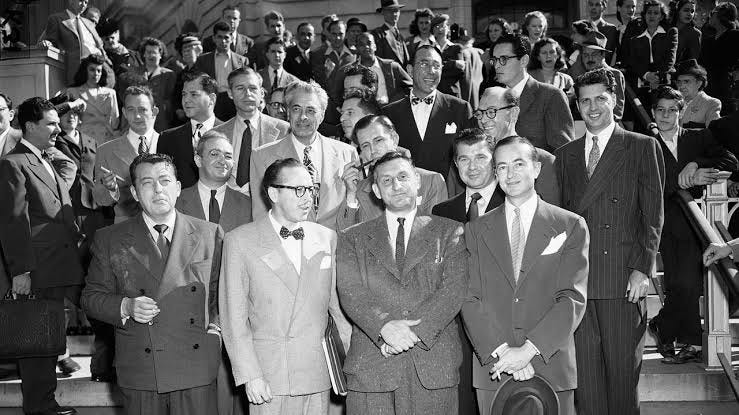
| The Hollywood 19 |
These questions were sent to me by email by the Italian critic Maurizio Porro. If I have understood correctly, he used parts of my responses in his Corriere della Sera article on the forthcoming Hollywood Blacklist retrospective that I have curated for the Locarno Film Festival. — EK
Are there obvious points of contact between the titles?
They’re all connected like the branches of a tree. Some of those branches are revealed to be connected by this programme for the first time.
The most immediate connection is the central narrative, which traces the cinema of the radical and the left in Hollywood from the US entry into the Second World War and its alliance with the USSR through to the formation of the House Un-American Activities Committee (HUAC) hearings for Hollywood, the blacklist that ensued, and eventually the gradual demise of this system of arbitrarily banning talent from working in the film and television industries.
These films are also connected by individuals—either in front of or behind the camera—who were targeted by the witch hunt. If you ask me why an Argentine film by a French director, such as Native Son, is in the programme, I would answer that the writer of the novel on which the film was based—the great Richard Wright—was also targeted during the McCarthy era. Unable to make the film in the US, it was produced in Argentina. Nobody dared to play the leading role, so Wright himself appeared in it. The programme therefore offers an expansive notion of the blacklist that even includes the jazz bandleader and clarinetist Artie Shaw. We will also screen one of his short films.
What lens or perspective were they chosen with?
The lens of storytelling. This is the most story-oriented retrospective I have curated so far. The selected films are meant to become characters in the story of the blacklist.
There are key films whose names always come up whenever one reads about the blacklist, such as Tender Comrade, which we will screen. Then there are films whose names are rarely heard these days, but which were equally disruptive and subversive in the eyes of the House Committee on Un-American Activities, such as Edgar Ulmer’s Ruthless.
This programme is about both the known and the unknown—or the little-known. I also made a list of all the people who should be part of the story, whether as political fighters (Dalton Trumbo), martyrs (John Garfield), or infidels (Clifford Odets, Elia Kazan). I also introduce figures who are usually not celebrated as blacklisted filmmakers, but whose careers suffered greatly because of the Red Scare, names such as John Cromwell and Michael Gordon. Cromwell, for instance, was named because the Hollywood star Adolphe Menjou testified that, during a dinner at Cromwell’s home, he had said that capitalism couldn’t last. Imagine informing on the person who invited you and your wife to dinner over something they said during the evening.
Which film was the most watched and discussed, or sparked the most controversy?
The most controversial is definitely Mission to Moscow. It was made by Warner Bros. at the direct request of President Roosevelt, who wanted to promote goodwill with the Soviet allies. The film whitewashes the Moscow Trials and paints Stalin in a positive light. It is a crazy piece of propaganda—so one-sided and, in a way, utterly silly. But it is also essential viewing because of the consequences it had for its creators. It became Exhibit A during the HUAC hearings.
What was left of those controversies afterward?
Debris, heartbreak, unhealable wounds, and a loss of trust in democratic institutions—a cultural trauma. Its impact continues to this day. Even the terminology has resurfaced under the Trump administration. The Cold War fractured America, and the blacklist was one of the most visible signs of that cultural split, one that has never been fully mended.
How much weight did the major studios and big stars carry?
Since the majority of the films were produced by the major studios, you will see great stars and major studio productions throughout the programme. After all, it is fascinating to see how films viewed by millions could—or could not—carry subversive messages about capitalism, fascism, and racism. We have films featuring Cary Grant, Jennifer Jones, Gary Cooper, and, of course, the retrospective’s poster boy, the wonderful and tragic John Garfield.
But there will also be films made in exile in places such as Italy, Mexico, England, and France, produced by smaller, independent companies, sometimes not even carrying the real name of the blacklisted filmmaker.
There will also be world premieres of two new documentaries. One is Dangerous Citizen: The Life and Times of Abraham Polonsky, directed by Steven C. Smith and written by Eddie Muller. The second, The Hollywood Blacklist: The Survivors Tell Their Stories, is built around footage shot in Los Angeles in 1983, when many surviving blacklist figures gathered for a dinner. These will play alongside classic documentaries about the blacklist, beginning with John Berry’s activist film The Hollywood Ten (1950).
Do similar problems exist today in Trump’s United States?
No, not in the horrific and irrational form they did between 1947 and 1959, when people were barred from seeking employment. But the reliance on the language of intimidation, smear campaigns, and portraying opponents as subversive and anti-American has returned to contemporary political discourse, and it is having its own devastating impact on culture.

No comments:
Post a Comment