
 |
| Body and Soul |
Brief notes on all the titles to be screened in Locarno as part of the Red & Black retrospective. — EK
.
Symphony of Swing (Joseph Henabery, 1939)
A groovy jazz short featuring sumptuous compositions and trick shots of Artie Shaw and his orchestra performing four songs, including a smashing version of Lady Be Good. Shaw was blacklisted in 1953. He subsequently abandoned music and went into self-exile in Spain.
Mission to Moscow (Michael Curtiz, 1943)
“Stalinism with New Dealism with Hollywoodism with journalism with opportunism with shaky experimentalism with mesmerism with onanism, all mosaicked into a remarkable portrait of [Soviet Union as] a great glad two-million-dollar bowl of canned borscht, eminently approvable by the Institute of Good Housekeeping.” James Agee
Mr. Lucky (H. C. Potter, 1943)
When a cunning gambler (quintessential Cary Grant) falls for a glamorous upper-class woman who runs a war relief charity, he not only changes his ways but also turns his talents with the dice to the war effort. Directed with finesse by comedy expert H.C. Potter.
The North Star (Lewis Milestone, 1943)
Lillian Hellman’s only original motion picture script is about a Ukrainian village’s fight against the Nazis, directed with astonishing vigour by Odesa-born Lewis Milestone. Despite typical falsifications, the film offers a rare glimpse into a Hollywood unwittingly endorsing the achievements of Marxist-Leninist society.
Tender Comrade (Edward Dmytryk, 1943)
Cited endlessly during the Red Scare as an example of a Bolshevik subversion of American cinema, it is about a group of factory women who in absence of their drafted men live collectively and fight their own battles at home, including against prejudice and ignorance.
None But the Lonely Heart (Clifford Odets, 1944)
One of Cary Grant’s finest and most personal films is a moving portrait of an idle Cockney in East London on the eve of the World War II. Theatre giant Clifford Odets’s cinematic debut, reflecting his ambition to develop a form of proletarian art within Hollywood.
The Heart Newsreels (1947-48)
Original newsreels and in once case raw footage produced by the Hearst media to bash communists and glorify the HUAC hearings, including Alleged “Red” Defies Congress!, F.B.I. Chief Hoover Exposes Communists!, Eric Johnston on Communism!, Film Industry Denies “Red” Influence, and Washington’s Movie Drama!
Smash-Up: The Story of a Woman (Stuart Heisler, 1947)
A talented singer (Susan Hayward) abandons her career for marriage and motherhood. Unable to accept the change, she turns to alcohol. This proto-feminist melodrama, exploring female insecurity in a male-dominated world, is based on a Dorothy Parker story and written by John Howard Lawson.
Crossfire (Edward Dmytryk, 1947)
A canonical film noir depicting a GI’s senseless killing of a Jewish man, it left a lasting mark on American cinema through its bold, timely confrontation of anti-Semitism, as well as its gritty imagery and shadow-drenched compositions, captured by cinematographer J. Roy Hunt.
Body and Soul (Robert Rossen, 1947)
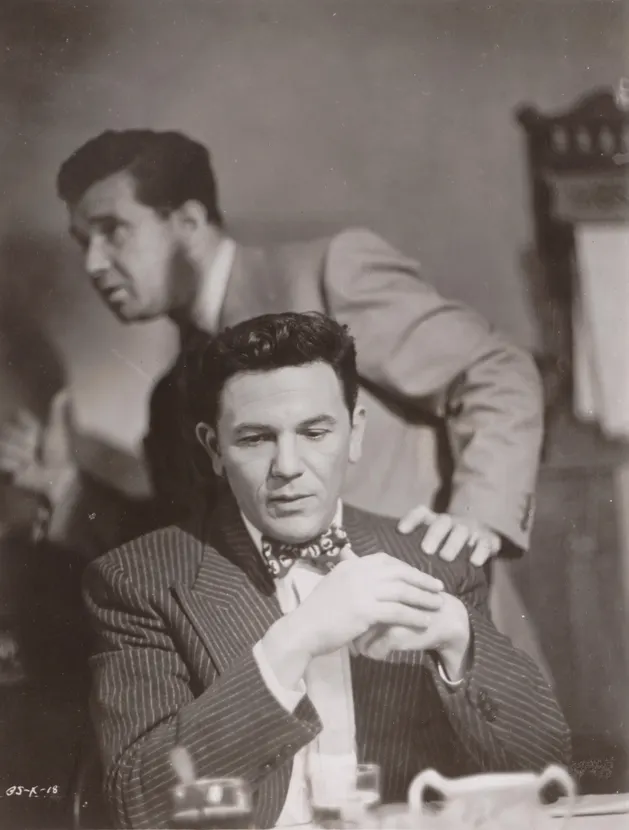
A nearly flawless portrait of a doomed man ensnared by capitalism, written by Abraham Polonsky and starring John Garfield, in which a small-time fighter seeks to rise from the slums to glory. “May be the reddest movie Hollywood ever produced” (J. Hoberman).
Ruthless (Edgar G. Ulmer, 1948)
Merciless film noir from the poet of stylised doom on ultra-low-budget, Edgar G. Ulmer chronicles the rise of an unscrupulous financier who exploits everyone around him. According to a confidential report, FBI was clearly alarmed: “Anti-capitalist in character, and replete with Communist propaganda.”
The Amazing Mr. X (Bernard Vorhaus, 1948)
A curious tale of a woman haunted by memories and the ghostly presence of her husband, who turns to a “spiritualist.” It features some of the most otherworldly images captured by John Alton, shifting from Poe-esque to political phantasmagoria.
Force of Evil (Abraham Polonsky, 1948)
John Garfield plays a corrupt lawyer aiding gangsters who prey on small businesses – until he targets his own brother’s bank. Polonsky’s directorial debut, just before the blacklist sidelined him for twenty years, is a masterpiece in which “people talk about money almost scripturally” (Imogen Sara Smith).
We Were Strangers (John Huston, 1949)
A pro-Cuban revolution film set in the final days of the Machado dictatorship, where revolutionaries plot to assassinate the dictator. Its depiction of antifascists as hip and heroic anticipates later films, including European partisan movies. Written by Peter Viertel, it portrays political idealism sliding into self-destruction.
Not Wanted (Elmer Clifton, Ida Lupino, 1949)
The daring story of an unwed mother, written by future blacklistee Paul Jarrico, was originally to be directed by Elmer Clifton, who suffered a heart attack before shooting. Ida Lupino took over but sadly remained uncredited. The film’s unexpected success, however, launched her remarkable directing career.
Thieves’ Highway (Jules Dassin, 1949)
A tough noir with roaring engines, set in the world of truckers in which a GI (Richard Conte) returns home to find his father crippled in an accident caused by the unscrupulous dealer. Determined to avenge him, he becomes a trucker, driving all the roads to hell.
Intruder in the Dust (Clarence Brown, 1949)
A subtle adaptation of William Faulkner’s novel, shot in his hometown of Oxford, Mississippi, it tells the story of a black man (Juano Hernández) accused of murdering a white man. With a lynch mob waiting outside his cell, why does he seem indifferent to his own defence?
Woman in Hiding (Michael Gordon, 1950)
A first-rate film noir in which a woman marries for love, only to discover her husband married for money – and to claim it, he must kill. Tautly directed by leftist Michael Gordon, it examines how greed corrodes the sacred American institution of family.
The Sound of Fury (aka Try and Get Me) (Cy Endfield, 1950)
Inspired by a 1930s California lynching, this film noir is “conceivably the most anti-American Hollywood picture ever made,” according to Jonathan Rosenbaum –“virtually flawless, exposing class hatreds and the abuses of the American press with rare lucidity and anger.”
The Hollywood Ten (John Berry, 1950)
A landmark of activism in American cinema, this fundraising and awareness film portrays the Ten’s plea before imprisonment. Director John Berry was blacklisted a year after making it.
Caged! (John Cromwell, 1950)
Directed by John Cromwell, a liberal whose career was interrupted by false communist accusations, this uncompromising women’s prison drama – earning Eleanor Parker an Oscar nomination – follows a frightened, beguiled pregnant woman imprisoned for allegedly aiding her now-dead boyfriend in a robbery, only to emerge hardened.
Shakedown (Joseph Pevney, 1950)
The directorial debut of former actor Joseph Pevney is a hard-hitting film noir. Co-written by future blacklistee Alfred Lewis Levitt, it follows a photographer (Howard Duff) who succumbs to capitalism’s everything-for-sale mentality, using his art as a passport to quick money – and even blackmail.
Broken Arrow (Delmer Daves, 1950)
Written by blacklisted Albert Maltz, this glorious western follows a former cavalry officer (James Stewart) who befriends and lives among the Apaches – until white warmongers shatter the peace. One of Hollywood’s earliest sympathetic portrayals of Native Americans.
Native Son (Pierre Chenal, 1951)
A unique adaptation of Richard Wright’s celebrated novel, exploring racism and fear in Chicago, with Wright himself in the lead after no one else dared. Impossible to film in the US, it was shot in Argentina by French director Pierre Chenal.
He Ran All the Way (John Berry, 1951)
Terribly stark, even by gangster/noir standards, John Garfield’s final film tragically mirrors his own struggle to clear his name after Red accusations and blacklisting. It follows a criminal who, after a robbery and killing a guard, takes a girl’s family hostage to hide in their home.
High Noon (Fred Zinnemann, 1952)
On his wedding day, Marshal Will Kane (Gary Cooper) must choose between confronting a ruthless gang or fleeing with his bride. With the craven townspeople paralysed by fear, Zinnemman’s McCarthy-era allegory is the western that in its unity of time and space defines classicism.
Stranger on the Prowl [Italian title: Imbarco a mezzanotte] (Joseph Losey, 1952)
Made by blacklisted exiles – producer John Weber, writer Ben Barzman, and director Losey at his best – the film follows a man (Paul Muni) hunted for murder, whose doomed flight from Italy is complicated by an orphaned boy who joins him.
¡Bienvenido, Mister Marshall! (Luis García Berlanga, 1953)
One of Spanish cinema’s great classics, this lively comedy follows a Castilian village posing as Andalusian to appear more “authentically” Spanish, aiming to impress visiting American dignitaries during the Marshall Plan. It delivers sharp commentary on Americanism and even touches briefly on the blacklist.
Salt of the Earth (Herbert J. Biberman, 1954)
A landmark film and the collective product of blacklisted talents – including director Biberman, producer Paul Jarrico, and writer Michael Wilson – this follows a New Mexico mining community on strike, where women assert themselves in a world supposedly reserved for men.
Silver Lode (Allan Dwan, 1954)
On his wedding day, Dan Ballard (John Payne) is accused of murder and must clear his name while facing a town turned against him. This lean and agile western “suggests the fragility of our democratic institutions,” noted Martin Scorsese.
On the Waterfront (Elia Kazan, 1954)
Terry (Marlon Brando) must summon the courage to expose illegal waterfront activities, putting him in conflict with his own brother. A breathtaking classic, it was also “a therapeutic struggle to find self-absolution” (Peter von Bagh) for Kazan and Budd Schulberg, who had “named names” during the McCarthy era.
The Intimate Stranger [US title: Finger of Guilt] (Joseph Losey, 1956)
The most strikingly self-reflective McCarthy-era film by blacklisted exiles – director Joseph Losey and writer Howard Koch, both under pseudonyms – follows an American filmmaker (Richard Basehart) exiled in Britain, trying to clear his name but sinking scene after scene.
Celui qui doit mourir (Jules Dassin, 1957)
Exiled filmmakers – writer Ben Barzman and director Dassin – adapt Nikos Kazantzakis’s Christ Recrucified, set in a Turkish-occupied Greek village in 1921. When a stuttering shepherd is cast as Christ for the annual Passion Play, events unfold as 2,000 years ago, now charged with a powerful ethos of resistance.
A King in New York (Charles Chaplin, 1957)
A deposed European king in New York dreams of using atomic energy to build a utopia, only to clash with Americans’ worldview. Chaplin’s anti-McCarthyism masterpiece – his first film after US exile – was so provocative it remained unreleased in the country it critiqued for twenty years.
City of Fear (Irving Lerner, 1959)
A jailbreak fugitive carries a canister he believes holds heroin – but it contains deadly radioactive material. Police race to contain him before the entire Los Angeles area goes up in a mushroom cloud. A striking study of fear, shot on location by Lucien Ballard.
The Young One [Spanish title: La joven] (Luis Buñuel, 1960)
Director: Shot in Mexico as a stand-in for America, this “neglected masterpiece” (Jonathan Rosenbaum) marked the second collaboration between blacklisted writer Hugo Butler and Spanish exile Buñuel, blending surrealistic subtleties with civil rights themes and Lolita motifs in a characteristically ironic, ambiguous manner.
All Night Long (Basil Dearden, 1962)
Set over a single night, an interracial marriage is sabotaged by a deceitful man. This excellent British film fuses blacklist-era themes of backstabbing and deception (via Othello) with the jazz world, featuring legends like Charles Mingus and Dave Brubeck.
Point of Order (Emile de Antonio, 1963)
A compelling “courtroom drama” with an astonishing twist marking McCarthyism’s downfall, this documentary is constructed entirely from raw footage of the 1954 Army-McCarthy hearings. It boldly refuses any intervention (no voice-over!), still delivers a thrilling portrait of decency vs turpitude.
The Hat (Faith Hubley & John Hubley, 1964)
Two soldiers on opposite sides of the border debate… borders. This bare and beautiful short animation features characters inspired and voiced by American jazz trumpeter Dizzy Gillespie and English actor-pianist Dudley Moore.
España otra vez (Jaime Camino, 1969)
In a story by former Lincoln Brigade fighter Alvah Bessie, a neurosurgeon returns to Spain after thirty years to revisit the people and places he fought for during the Civil War. The result is a brooding, mysterious film, deeply sincere in examining the legacy of the American Left.
The Front (Martin Ritt, 1976)
The first studio account of the blacklist was conceived as a comedy, with Woody Allen playing a clerk who fronts blacklisted screenwriters for some extra cash. Immersed in his new role, he heads for something between tragic downfall and heroic epiphany.
Hollywood on Trial (David Helpern, 1976)
The first detailed feature documentary on the blacklist marked a turning point in public understanding of the McCarthy era’s inner workings, featuring memorable interviews with Hollywood Ten members and narration by John Huston.
Red Hollywood (Thom Andersen, Noël Burch, 1996)
A monumental essay film that transforms gossip, hearsay, and trivia into a cohesive, authoritative study of Hollywood Left cinema. It analyses 44 films by blacklisted writers and directors while featuring interviews with survivors of the witch hunt.
La Liste Noire d’Hollywood: Par ceux qui l’ont vécue (Marie-Dominique Montel, Christopher Jones, 2026)
Featuring previously unseen footage of an early 1980s Los Angeles party honouring the last surviving blacklist members (including Lionel Stander, Karen Morley, Jules Dassin, and Lester Cole), the film conveys palpable pain and indignation, yet shows neither regret nor resentment.
Dangerous Citizen: The Life and Times of Abraham Polonsky (Steven C. Smith, 2026)
A detailed portrait of a cultural icon, the celebrated, feared, maligned, and blacklisted writer/director Polonsky, described by Eddie Muller – the main force behind this documentary – as “the greatest living American screenwriter.” It features rare archive with Polonsky, as well as new ones friends, admirers, and students.
 |

No comments:
Post a Comment