
 |
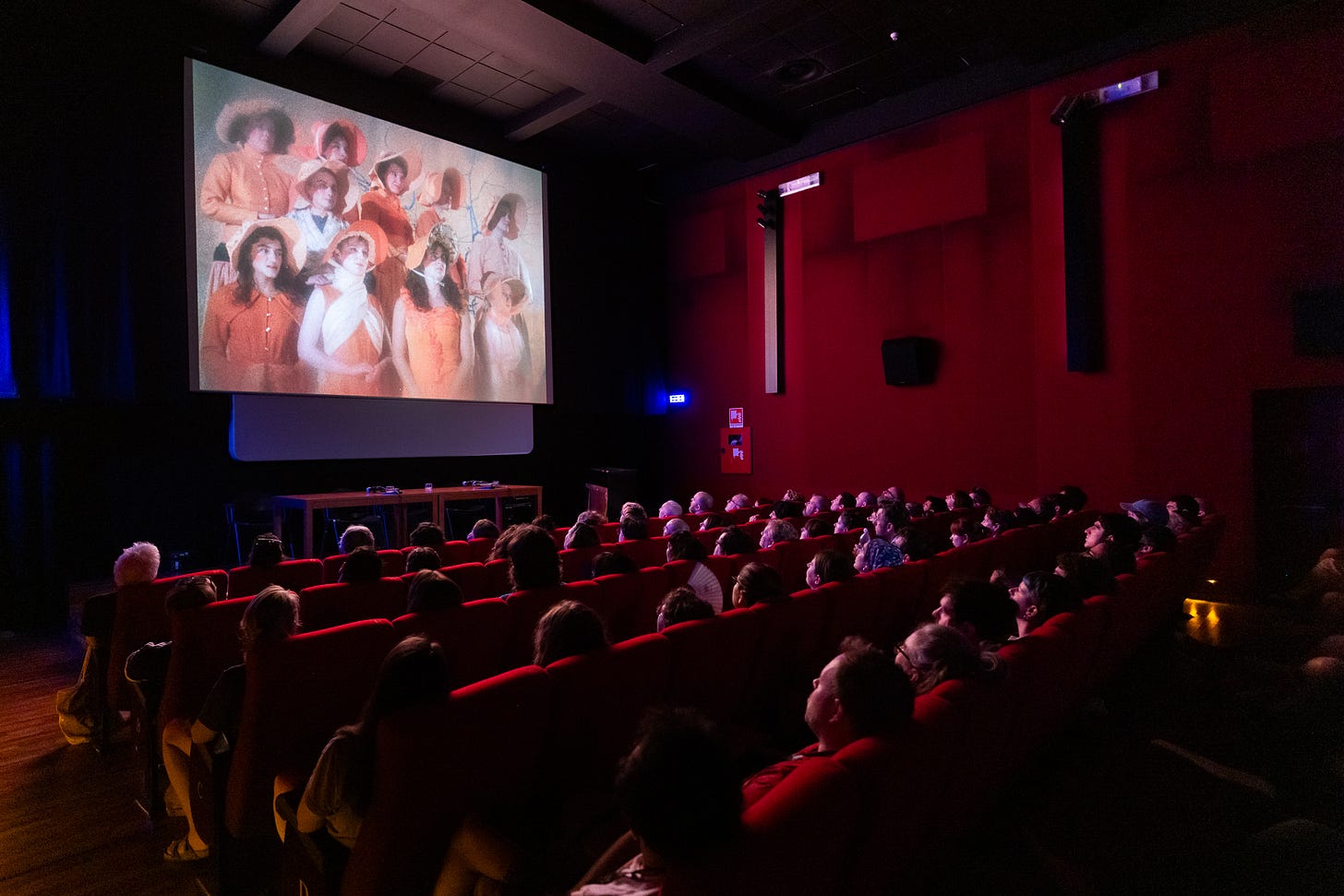
| Screening of Guy Maddin's Careful at Sala Scorsese |
I was interviewed by Spanish journalist David Pardillos Rodríguez for Infobae España via email. I share my responses here. — EK
- Please introduce yourself to our readers who may not know you: what is your role, and what do you do for the festival? What is a typical day like for you as you prepare for this year’s edition?
Along with Gian Luca Farinelli, Cecilia Cenciarelli, and Mariann Lewinsky, I work as a co-director of Il Cinema Ritrovato, the annual film festival in Bologna dedicated to film history, preservation, and restoration. There is no “typical” day in what we do. Our work more closely resembles the struggles of a hunter at night. You go out and seek the game. Many nights you come home empty-handed. Some nights you come home with something you believe can feed a large family with a large appetite for essential cinema. And then there are those rare nights when you capture the tiger. It involves watching a huge number of films and trying to figure out how they can be arranged into meaningful juxtapositions and illuminating strands.
- I like to think of Il Cinema Ritrovato as a kind of World Cup—ironic now that the World Cup is coming up and Italy isn’t participating in it—but with films instead of football. How would you explain it in your own words? I think it’s a festival unlike any other because of its old films, its atmosphere, location, and theaters…
It’s like a party, for sure—a communal celebration of cinema in all shapes and forms. All-inclusive, and an orgy of films that each attendee experiences in a completely different and highly personal order. In that sense—and I hope this won’t come across as smug—Il Cinema Ritrovato is one of the few festivals in the world that offers a truly democratic range of films. There are as many versions of Il Cinema Ritrovato as there are people who attend it.
- You also work for Locarno; how different is the work at one festival compared to the other?
Locarno is a festival of contemporary cinema with a strong, highly respected retrospective section. In Locarno, everything revolves around one theme and is screened in a single cinema. In a way, Locarno is like a crash course on one particular subject, whereas Il Cinema Ritrovato is an exercise in cinematic anarchy.
- This is the festival’s 40th edition. After all this time, how do you manage to keep a festival dedicated to classic cinema viable and profitable—one that doesn’t rely on red carpets or big stars (unless they’re still alive) as headliners—if it is, in fact, profitable? After all, you often work with original prints and feature live music… all of which must require a considerable budget.
Art is no longer profitable, except when it is handled by corporations, agencies, and those who want to make money from it. Il Cinema Ritrovato is fully dedicated to the idea of pure art, and how it manages to survive is a question that should be put to the brilliant team handling the festival’s financial side. They perform magic, I believe.
- When I was there last year, I was amazed by how diverse the audience was and, above all, how engaged they were with all the screenings and presentations. How do you achieve that connection to foster a new generation of film lovers?
It’s partly organic and partly due to the expansion of the programme into directions that were not among the festival’s main identities, let us say, ten years ago. That has attracted people of different age groups and social backgrounds. But once they are in Bologna, all of a sudden they begin experimenting and moving beyond the initial framework that brought them to the festival, cherry-picking films from different strands and immersing themselves in the totality of the event.
- Regarding this edition, you’re featuring a retrospective on a Spanish filmmaker, Juan Antonio Bardem. What interested you about this director, who is a major figure in our country on par with Buñuel or Berlanga?
I have been an unconditional admirer of his work ever since I saw Calle Mayor, although it was La venganza that shook me most profoundly. What I like about his films are the subversive qualities he maintained during the dictatorship and the brevity with which he used post-war European modernism to tell stories that were so distinctively Spanish.
- You’ll also be featuring special series on screwball comedy, focusing on Mitchell Leisen and Barbara Stanwyck. I have to confess is on of my favorites genre. What can you tell me about screwball, which has fallen somewhat out of favor today, and about the importance of both Leisen and Stanwyck in the history of cinema?
I would beg to differ. Although Leisen has always been labelled as a screwball director, his films are in reality less screwball than they are entrenched in melodrama. His comedies are not as goofy as, shall we say, those of Preston Sturges. He inhabits a domain of his own—partly self-invented—in which sophistication of style, language, and sexual shenanigans is far smoother and subtler than in the work of many other masters of the genre.
The selection assembled by Molly Haskell for the Stanwyck strand also paints a richly varied portrait of her career, ranging from pre-Code melodrama to comedy, from film noir to the western. In fact, half of the films in that selection are rather dark works.
- As a journalist but also as a film passionate, it’s a breath of fresh air for me to watch films from so many years ago and see that, in many ways, they have a much more appealing visual style than today’s films. Since you’re a filmmaker as well as a programmer, is Il Cinema Ritrovato, in its own way, a form of resistance against today’s cinema, which has standardized and homogenized its image—the so-called “Netflix Lightning”?
If it is a form of resistance, it is a resistance against banality and against disregard for history and truth. If it is a celebration, it is a celebration of form, beauty, style, and unassuming art. We do our own little thing, and if that appears, from the outside, to be a deliberate attempt to counter the commercialisation of cinema, then all the better.
- I follow your newsletter and have seen some of your recommendations for this 40th edition in recent days, but if you had to choose just five of them, which ones would they be? And just from Juan Antonio Bardem?
Tarva Yeghanakner, Darling, How Could You!, Ten Seconds to Hell, Dayereh-ye Mina, and of course La venganza.
- Finally, what are your expectations for this 40th edition, and what future do you foresee for the festival?
That it remains enjoyable and continues to offer opportunities for discovery and self-illumination. If that works, then we are already in the future, walking through it and shaping it through the choices and directions we pursue today.

No comments:
Post a Comment