
 |
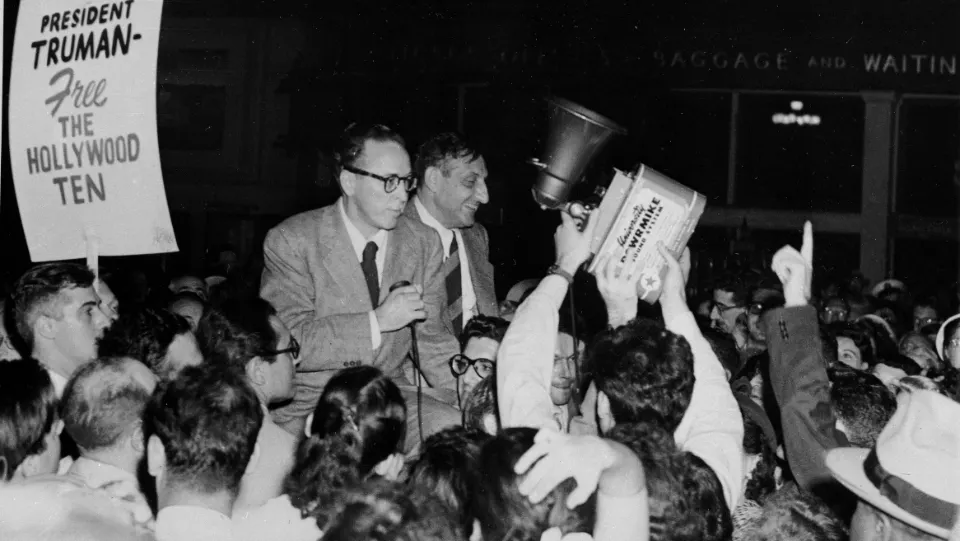
| Dalton Trumbo (left) and John Howard Lawson campaigning before being sent to prison in 1950 |
This interview with me was conducted by Georg Szalai for The Hollywood Reporter. You can read Georg's intro here. — EK
Georg Szalai: Have you been working on this retrospective for Locarno for a long time, and how easy was the decision that the time was ripe for it?
Ehsan Khoshbakht: I had this project lined up for later because it needed more research, but suddenly it felt senseless to delay it any further—it’s about what’s happening right now. Even some of the terminology has come back into use. Just look at recent press releases from the White House. You’ll find phrases that sound like they come straight out of the McCarthyism playbook: “Radical Left Lunatics,” “subversive un-American,” and so on.
What’s especially interesting is that the Left, the Right, and even the center have all appropriated the language of that era for their own purposes. There’s a mix here of genuine confusion—often rooted in a limited understanding of the historical context—and a more deliberate effort to repurpose language for one’s own ends.
Curating retrospectives takes a lot of work and research. Can you share some insight into how long you researched this topic and these films?
I had seen almost all of the films before, so it became more a question of which combinations might be the most illuminating. The subject also comes with hundreds of books and publications, so much of my research time went into catching up with the literature. There are also oral histories and memoirs written by victims of the blacklist—especially the Hollywood Ten—from the late 1970s onward, reflecting on their own experiences. These accounts reveal contradictions, paradoxes, and, at times, a degree of self-aggrandizement. There are also other fascinating materials, such as declassified FBI files, which make it especially compelling to delve into this chapter of American cinema history.
I love the title you guys picked for the retrospective, Red & Black – Hollywood Left and the Blacklist. How long did you think about what to call this showcase?
There’s a bit of Stendhal in it—Stendhal on a scandal! Many strong titles have already been claimed by book authors. One I’m particularly fond of is Tender Comrades [A Backstory of the Hollywood Blacklist].
I wanted the title to signal that this isn’t about a single subject, but really two. One is “red,” and the other is “black.” “Red” refers to the Hollywood Left, which was active before the blacklist was introduced in 1947, while “black” points to the blacklist itself. The program traces the trajectory of the Hollywood Left from the early 1940s through to the late 1960s.
When Locarno unveiled this latest retrospective, you said this is the most timely retrospective you have put together. This is your third one for the Locarno festival, but you have done so much other work. How is this one different?
Because it is about a series of political and industrial missteps, and I can’t help feeling that some of them are being repeated today, albeit in subtler but equally troubling ways.
It’s also important to note that The Hollywood Reporter was a key player during the blacklist era, effectively acting as a cheerleader for the FBI and for the HUAC.
If I had to point to one primary cause of the blacklist, I would highlight the union battles—particularly those involving the Screen Writers Guild, which was deeply unpopular with Hollywood moguls and with The Hollywood Reporter. There was a clear resistance to writers gaining influence. The publication seized every opportunity to attack those involved in forming the Guild, going so far as to omit the writer’s name from film credits in its reviews if the writer was someone like Lester Cole.
In one especially pointed attack on Cole, the paper ran a front-page editorial revealing his Communist Party membership number—information that was meant to be secret, and which even Cole himself did not possess. The FBI, however, had infiltrators within the Communist Party and had obtained that, which was then weaponized against him.
Some of the other faces and names that audiences will come across in the retrospective include the likes of John Garfield, Dorothy Parker and Charlie Chaplin. Can you talk about some of the big names and what roles they played?
We can distinguish three broad groups: non-Americans, non-Hollywood figures, and the Hollywood Left.
Among the non-Americans are figures such as [German playwright] Bertolt Brecht, who testified before the House Un-American Activities Committee and left the country the very next day, never to return. There was little the authorities could have done to him anyway—since he wasn’t an American citizen, deportation would have been their main option.
Charlie Chaplin falls into a similar category, as he too was not an American citizen. But his case is far more complex. Even before the Communist Party began to grow in membership, Chaplin was already under surveillance by the FBI. The records on him are extensive, and some will be published in a book I’ve edited on the blacklist. They tracked his every move, likely because of his immense global visibility—arguably the most recognizable person in the world at the time—and his progressive views.
At the beginning of the war, when the United States was still neutral, Chaplin—being British—actively campaigned for antifascist causes. Later, once the U.S. entered the war, he supported the Soviet as allies, in line with what Franklin D. Roosevelt encouraged to promote wartime goodwill. The level of hostility directed at Chaplin—including antisemitic narratives circulated by Hearst Communications and echoed in FBI materials—was extraordinary.
The second group consists of individuals not typically associated with Hollywood, but still affected by the blacklist. Figures like Dorothy Parker, for instance, moved in and out of Hollywood but were fundamentally rooted elsewhere. Similarly, the program includes Richard Wright, a major African American literary figure, and Artie Shaw, the jazz musician and bandleader who eventually went into self-imposed exile in Spain.
Finally, the third group includes prominent Hollywood figures who were directly affected, such as the Hollywood Ten and many others. In fact, the program extends well beyond the Hollywood Ten, partly because some of those outside that group present even more complex and revealing cases.
One striking feature of earlier blacklist retrospectives is their reluctance to include the work of those who “named names”—individuals who ultimately cooperated with investigators. Many such programs have, perhaps unintentionally, reinforced a narrative of political martyrdom. That’s not a perspective I share. My interest lies in examining the full spectrum of the Left—whether individuals remained committed to their beliefs or became collaborators.
A telling example is Ben Maddow, one of the finest writers in Hollywood. Over time, he found it increasingly difficult to accept that scripts he had written were appearing on screen under someone else’s name. Eventually, he chose to cooperate and name names. Politically and ideologically, that decision marked a failure; arguably, it also represents a major ethical compromise. And yet, as a writer, his work remains exceptional.
I noticed that your retrospective is mixing genres and types of media, including not just films, but also old newsreels...
Yes, I’m trying to present a more diverse – but also more accurate – picture of the Left and the blacklist in Hollywood. That’s why I decided to broaden the scope of the material, in collaboration with the UCLA Film & Television Archive, our partner on this project. They hold an exceptionally strong collection on the subject.
They have also digitized original Hearst newsreels which, in terms of media support for the witch hunt, was at the forefront. Hearst produced a number of sharply worded anti-communist newsreels, and I’m including six of them in the program.
We have close to thirty 35mm prints, many of them coming from the UCLA Film & Television Archive—fantastic prints. The BFI, the Library of Congress, and the Hollywood studios have also been extremely helpful.
Your retrospective also mixes fiction and documentary features. What docs can audiences expect?
There will be world premieres of two new documentaries. One is Dangerous Citizen: The Life and Times of Abraham Polonsky, directed by Steven C. Smith and written by Eddie Muller—the latter widely regarded as a leading authority on film noir. The title comes from a declassified BFI file that described Polonsky as a politically “very dangerous” figure. Polonsky was a remarkable writer who directed only one film, Force of Evil, before being blacklisted. He didn’t direct again for two decades, returning with Tell Them Willie Boy Is Here, starring Robert Redford. Muller has even argued that Polonsky may be the greatest writer in American cinema.
The second documentary, The Hollywood Blacklist: The Survivors Tell Their Stories, is built around footage shot in Los Angeles in 1983, where many surviving blacklist figures gathered for a dinner. The material, which had deteriorated significantly over time but has now been restored, remained unseen until now. It is directed by Marie-Dominique Montel and Christopher Jones, and features participants such as Jules Dassin, Karen Morley, and Albert Maltz, among many others.
You mentioned the political situation and division in the U.S. of our day. How much political consciousness and activism do you see in current Hollywood?
I haven’t seen that many films coming out of Hollywood these days, but some major recent titles—such as One Battle After Another by Paul Thomas Anderson—are quite explicit in their engagement with these themes. Anderson seems genuinely interested in the blacklist period; the film reflects one of the many ways that a culture of radical politics can evolve into disillusionment and, in this case, even political violence.
More broadly, if you compare contemporary Hollywood films to something like Force of Evil, where corruption permeates every level of society, recent films often feel comparatively tame and apolitical. The cinema of the Hollywood Left was bold, yet still accessible to a wide audience. Even though films became more overtly political in the 1960s and 1970s, they also grew more niche, appealing to smaller, more specific audiences—and in doing so, they lost some of that mass reach. In that sense, the left-leaning films of the 1940s remain quite unique.
Have you come across any particularly over-the-top, maybe even funny anecdotes in your research?
Many, especially when FBI agents start doubling as film critics! Some of their observations are hilarious. In one memo, the FBI warned that John Huston—fresh off an Oscar for his adapted screenplay for The Treasure of the Sierra Madre—had included a speech by Walter Huston that was “practically a direct quotation” from Das Kapital. The agents even began running some “classics” and expressing shock that Erich von Stroheim’s Greed depicted “how the pursuit of money corrupts all human values”!
It’s important to remember that many of the blacklisted writers and directors experienced the Great Depression first hand. They witnessed kilometer-long breadlines, extreme poverty, broken families, suicide, and mass unemployment. Their socialist leanings were, in large part, a response to what they saw as the failure of the capitalist system in the early 1930s. This was a period of intense political engagement, not only in Hollywood but across society, with people actively joining picket lines and labor movements. Robert Rossen, who won the Academy Award for Best Picture in 1949 for All the King's Men, was known to be on the front lines of picket lines during the labor struggles of the early 1940s.
Did Hollywood studios have actual concerns with the creatives on the blacklist?
Studios didn’t genuinely believe these writers posed a real threat. They largely gave in only under intense external pressure. In fact, there was a clear incentive to keep them employed, since their scripts were commercially successful and generated substantial revenue.
Once the blacklist took hold, much of the work simply went underground. Blacklisted writers continued to write under assumed names or through fronts, sometimes even winning major awards. Dalton Trumbo is a prime example. He won two Academy Awards after being blacklisted [first for Roman Holiday (initially credited to a front) and later for The Brave One (credited to the pseudonym Robert Rich)]. The Brave One, in particular, carries subtle political undertones.
Do you maybe have an example of a film in the retrospective from creatives who named names, as you mentioned earlier?
A very talented director I rate highly, Michael Gordon, had his moment of lapse, and I’m including one of his films, Woman in Hiding, from 1950. It stars Ida Lupino, the only woman directing films in Hollywood during the 1950s. But it’s difficult not to note that she also served as an informant for the FBI and named Sterling Hayden, who in turn named others, including his mistress!
Clifford Odets was perhaps the most significant artist to name names, though because his primary background was in theatre, he tends to receive less attention in this context than Elia Kazan. We’ll be screening a 35mm print of None But the Lonely Heart, directed by Odets and featuring a superb performance by Cary Grant as a Cockney—arguably his finest proletarian role.
The key film associated with those who named names is On the Waterfront. Three of the central figures behind it—director Kazan, screenwriter Budd Schulberg, and actor Lee J. Cobb—all cooperated with investigators.
Is there anything else you'd like to mention or highlight?
In the 1970s, Dick Cavett asked former blacklistee Lillian Hellman whether things were as bad during the Richard Nixon era as they had been during the McCarthyism period. She replied that they were—except that Joseph McCarthy was a clown you could laugh at, whereas Nixon was no longer funny.
I often wonder how those who were blacklisted might have responded to the present moment, when political purges and well-orchestrated smear campaigns have become so mainstream that they sometimes seem to define American politics itself.

Hi Ehsan its Omid from Film Mag, now living in London, I wonder if we can catch up and also do an interview? Please reply to get connected. Best omid omidha@gmail.com
ReplyDelete