Monday, 5 September 2022

Focus on Filmfarsi in Paris (September 2022)

Cry of Midnight AKA Midnight Terror (1962)

A listing of the Iranian films which will be screened at L'Étrange Festival in Paris, including my documentary Filmfarsi (2019). All screenings at Forum des images, September 2022.


Filmfarsi (2019)

Sep 9, 17:45 (introduction by Ehsan) | Sep 18, 18:30

“As a long standing admirer of the New Iranian Cinema, I often wondered about its popular predecessor. Ehsan Khoshbakht has finally opened up this story.  His essayistic, meditative and cinephile analysis celebrates an unashamedly exploitative genre, steeped in sex and violence; Filmfarsi very usefully locates this crazy cinema within the Iranian popular and political culture of its time, and also allows it to find a place in the wider context of World Cinema.” — Laura Mulvey

Szyfry (Wojciech Has, 1966)


Playing at London's Closeup Cinema on October 30, 2022. – EK


Championed for his intricate narratives and hypnotic imagery by people like Grateful Dead's Jerry Garcia, Luis Buñuel and Martin Scorsese, Wojciech Has uses a historical frame only to bend the notions of time and space. The result, Szyfry (meaning the codes), is one of the most complex Polish films about the moral dilemmas of Second World War.

Made right after his international breakthrough, The Saragossa Manuscript, and using the same star (Zbigniew Cybulski, in one of his final roles, before dying in an accident a year later), Szyfry is about a Second World War veteran returning to Warsaw from his long London exile to meet the wife and son he has left behind. The son (played by Cybulski), a former member of the resistance, open his father's eyes to the fate of the fourth member of their family, his disappeared brother, and the inconvenient truth that he might have been a Nazi collaborator. Featuring some of Has's most staggering dream/nightmare sequences, this rarely seen gem is one of the essential films of Polish cinema of the 1960s.

Tuesday, 23 August 2022

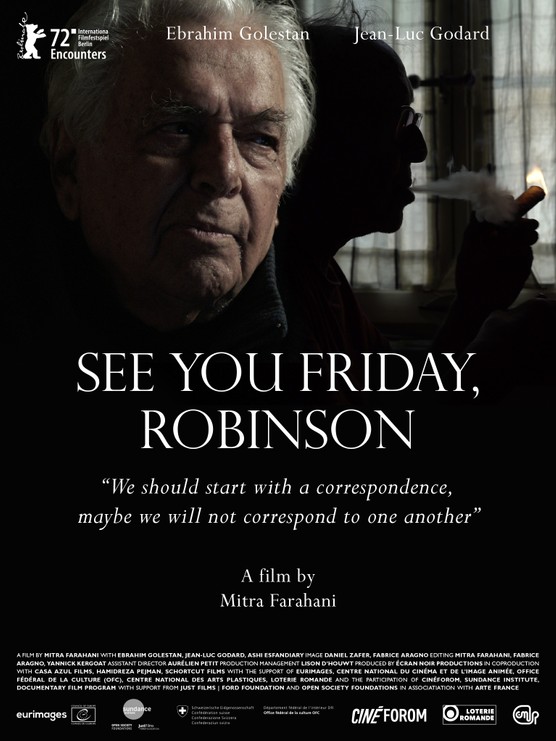
See You Friday, Robinson (Mitra Farahani, 2022)


RIP Ebrahim Golestan (1922 – 2023)


A long-distance dialogue between Ebrahim Golestan, a giant of Iranian cinema and literature (now only a few months shy of his 100th birthday) and Swiss-French filmmaker Jean-Luc Godard forms the basis of this latest film by Mitra Farahani. Among the most gifted documentarians from Iran, Farahani mediates between two seemingly irreconcilable worlds to create a unique epistolary work. Its elegant, hybrid style takes us from encounters with shadows – the first time we see each of these artists – to the inner lives of flesh and blood individuals; vulnerable, pained, caring, endlessly searching. 

Monday, 22 August 2022

One Way Street (Hugo Fregonese, 1950)

One Way Street, part of the Hugo Fregonese tribute, plays at MoMA on September 1, 18:30. It's a fine 35mm print, previously screened in Bologna in June 2022. – EK


After leaving Britain in bitter resentment, James Mason appeared in Hugo Fregonese’s Hollywood debut, somewhat appropriately, a film about life on the run. Mason plays Dr Frank Matson, a shady physician who takes off with a bag full of stolen money and the girlfriend of a gang leader, hiding out with her in Mexico. But fate knocks loudly on the door, echoing one of Fregonese’s major preoccupations: the encounter with death. “For no matter the tears that may be wept, the appointment will be kept,” the film’s opening title card bluntly announces.

Saturday, 20 August 2022

Doroshkechi (Nosrat Karimi, 1971)


The new digital copy of Doroshkechi that world-premiered at Il Cinema Ritrovato 2022 (for which this note was composed) is now (September 12, 16:00) playing at Forum des Images in Paris. I shall be introducing the Parisian screening of the film. – EK


Doroshkechi [The Carriage Driver] (Iran, 1971, black & white, 115 min)
Writer and Director: Nosrat Karimi
Writer: Nosrat Karimi. Cinematographer: Houshang Baharlou. Editing: Sirus Jarrahzadeh. Music: Mojtaba Mirzadeh. Cast: Nosrat Karimi (Gholamali), Shahla Riahi (Zinat Sadat), Masoud Asadollahi (Morteza), Arghavan (Pouri), Babak Karimi (Hassan), Ezattollah Navid, Diana. Producer: Manouchehr Sadeghpour. Scanned in 5K and digitally cleaned in 4K by CNC.

Wednesday, 27 July 2022

Hugo Fregonese: Man on the Run (MoMA retrospective, September 2022)

Blowing Wild

Perhaps history’s most restless filmmaker, Hugo Fregonese directed his first films in his native Argentina in the 1940s and then embarked on a globe-trotting career that took him to Hollywood, London, Paris, Rome, Munich, and eventually back to South America, all the while exploring themes of claustrophobia, entrapment, and imprisonment. This program, originally organized with Bologna’s Il Cinema Ritrovato festival of archival film, includes a new restoration of Fregonese’s boldly stylized Western Apache Drums (1951) and a new 35mm print of Fregonese’s masterpiece Black Tuesday (1954), a strikingly harsh and violent gangster film featuring Edward G. Robinson in his last thoroughly villainous role and spectacular noir cinematography by Stanley Cortez (Night of the Hunter).

Organized by Dave Kehr, Curator, Department of Film, The Museum of Modern Art, and Ehsan Khoshbakht, Co-Director, Il Cinema Ritrovato.

The series runs from September 1 to 15 in New York City. More info here.

Tuesday, 12 July 2022

Il Cinema Ritrovato 2022: Favourites & Discoveries

When they unscrewed the heavy and majestic La Nonna (our carbon arc projector) from the pedestal in Piazzetta Pasolini and the ice cream vendor packed his stuff and went home it was clear that Il Cinema Ritrovato XXXVI was over. We had a ball. More than 400 films were shown during 8 and a half days. Cinema could be found in every corner of the city.

After the last year's round-up – seen and read by many – I asked colleagues, curators, film historians, silent film accompanists, scholars and the attendees to pick the title of the two films from the festival, one as their favourite film and the other of their major discovery at this year's edition. You can read them below.

The magic of Bologna lies in the fact that while we showed films by the masters we love (Hitchcock, Lang, Ophuls, Melville), the filmmakers that are championed in this poll are Niskanen, Muratova, Fregonese, Shahid Saless, Rossi, and Ovanessian. Rewrite the film histories now!

See you next year!

THIS BLOG POST IS BEING REGULARLY UPDATED. THE NEW ENTRIES WILL BE MARKED BY [new]

* * *

Saturday, 21 May 2022

A View into Yugoslav Cinema by Mina Radović

Man Is Not a Bird

During its XXXVI edition, Il Cinema Ritrovato will present a section dedicated to Yugoslav cinema. The curator of the programme, Mina Radović, has written an introductory article, discussing the ideas behind the selection, as well as the significance of each selected title. All the films will play at the Jolly cinema of Bologna between June 25 and July 2, 2022.


“Tell the Truth!” A View into Yugoslav Cinema, 1955-1969

By Mina Radović


Yugoslav cinema represents a rich, multifaceted, and for many film connoisseurs, untapped resource of film heritage. One of the most diverse states in twentieth century Europe, Yugoslavia was originally founded in 1918 in the aftermath of the First World War and the collapse of several empires as the Kingdom of the Serbs, Croats, and Slovenes. The country was governed as a constitutional monarchy governed by King Aleksandar Karađorđević and in 1929 the country changed its name to Yugoslavia – ‘the land of South Slavs’.

A hub of film culture, pedagogy, and production, the film industry was nationalised after the Second World War and a sophisticated studio system quickly emerged. The new government led by Josip Broz Tito turned Yugoslavia into a socialist country with its own brand of self-management and a form of diplomacy which connected East, West, and the ‘Non-Aligned’ world.

The post-war years saw the rise of formidable new artists who examined, mediated, and challenged contemporary Yugoslav reality, breaking social taboos, and forging new means of cinematic expression. Their work is often diametrically different, but they are connected by an innovative, experimental, and altogether refreshing spirit to see the world anew. The retrospective will present two decades of cinema, moving from the Classical Cinema of the 1950s to the New Yugoslav Film of the 1960s and incorporates a range of feature and short, fiction, documentary, and experimental films by master filmmakers of the era.

Wednesday, 18 May 2022

Iranian Films at Il Cinema Ritrovato 2022

The Carriage Driver (Nosrat Karimi, 1971), shot by Houshang Baharlou (Chess of the Wind)

The forthcoming edition of Il Cinema Ritrovato (June 25-July 3, 2022) doesn't include an individual strand for Iranian cinema, however, it'll nonetheless feature at least five dazzling Iranian films, made between 1961 and 2022, shown across 3 different strands.

The documentary section will see the Italian premiere of À vendredi, Robinson (Mitra Farahani, 2022), a dialogue between Ebrahim Golestan, a giant of Iranian cinema and literature (now only a few months shy of his 100th birthday) and Swiss-French filmmaker Jean-Luc Godard. This is a truly beautiful work and should prepare you for what comes next.

A Fire (Yek Atash) by Ebrahim Golestan was premiered at Venice Film Festival in 1961. We screened it in 2016 when a retrospective was dedicated to Golestan's cinema of poetry and politics. Now we have updated the faded 35mm print previously shown with a 4K restoration of the film, presented for the first time in its original Persian voice-over, spoken by a famous voice artist, Asadollah Peyman. (The 2016 screening was from an English-dubbed version.) 

Friday, 22 April 2022

Interview with Hugo Fregonese

Hugo Fregonese

Films Can't Played Off Too Fast; Public Catch Up, Declares Fregonese

By Richard Bernstein

(The Independent Film Journal, November 1952)


"Phoniness in pictures, as in money, has no real value,” explained Director Hugo Fregonese at lunch. Fregonese has just returned from Europe where he directed the Mike Frankovich production, Decameron Nights, which stars Joan Fontaine and Louis Jourdan.

“I feel that an audience can sense a formula picture,” Fregonese said. “An audience likes to be surprised. They don't like to see the same film over and over with a different cast.”

Fregonese pointed out that nowadays a film goes through the theatre circuit too fast. Many pictures are worth a holdover and don't get it. Pictures should be exploited like plays for longer runs. Many times a person finally gets time to see a picture and finds that it has gone. By the time word-of-mouth on a film gets around, a film is sometimes not even playing in the city anymore.

Friday, 15 April 2022

Cinema Reborn 2022 catalogue (featuring The Deer essay)

The 2022 edition of Cinema Reborn focuses on the worldwide activity of film preservation and restoration. Held in Sydney from April 27 to May 1, the festival would see the Aussie premiere of The Deer (Masoud Kimiai, 1974) on which I have written an essay for the festival catalogue. The catalogue is now available in digital format and print formats.

Download the catalogue (in PDF) here.

Friday, 25 March 2022

The Drifter's Escape: Hugo Fregonese


THE DRIFTER’S ESCAPE: HUGO FREGONESE

A retrospective at Il Cinema Ritrovato, Bologna (June 25-July 3, 2022)

Curated by Dave Kehr and Ehsan Khoshbakht


As swiftly as some directors changed studios, Hugo Fregonese (1908-87) changed countries. The perfect ‘saddle tramp’ figure, he drifted and made films about drifting and escape. A master of brisk and unsentimental westerns and crime thrillers, with a career spanning over four decades and numerous bases of production – from his home country Argentina, to America, Spain, Italy, the UK and West Germany – Fregonese’s cinema is unjustly underappreciated to the point of obscurity. This is a step in the direction of claiming him as an important figure; one whose cinema of impassioned subjectivity blends the aesthetic of low-budget films with fatalism, myth and raw violence. Fregonese’s name is often associated with the ten films he made during his five-year residency in Hollywood in the 1950s. This programme picks some of the finest from that period to screen alongside films made elsewhere. Forming one of the most coherent cinematic oeuvres that one could expect from a wandering director, this will be one of the major revelations of Il Cinema Ritrovato 2022.

Friday, 11 March 2022

The Prose-Poetry Cinema of Ebrahim Golestan


"And the earth is a woman, with reveries and roots," says the Iranian filmmaker Ebrahim Golestan, narrating over the image of a 3,000-year old skeleton as it is unearthed, in his short documentary The Hills of Marlik (1964). This is where the heart of the filmmaker, who recently turned 100, lies: in the earth, to which he returns repeatedly in his films...


Read the full essay -- a tribute to Ebrahim Golestan -- in the March 2022 issue of Sight & Sound magazine.

Wednesday, 23 February 2022

Company Cinema in Abadan — A History (by Abbas Baharloo)

Taj Cinema in Abadan

Commissioned by me and originally published in the now defunct Underline magazine, this piece by the prolific (and Abadani) historian of Iranian cinema, Abbas Baharloo, sheds light on a lesser-known and nonetheless very significant chapter in the history of film culture in pre-revolutionary Iran. — EK


The Anglo-Persian Oil Company ushered in a ‘golden age’ of cinema-going in Abadan before nationalisation in 1951. Overseen by the Company, however, popular entertainment and propaganda were mixed, and screenings did little to bridge social divisions. 

By Abbas Baharloo


Many years ago now, Abadan was a city that welcomed immigrants and a place where many settled. Its population was made up of people from many different Iranian and international cities; Isfahanis, Shirazis, Baluch, Kurds, Lors, Arabs, and Azeris lived alongside Britons, Americans, Indians, and people from Rangoon in Burma. At the time Abadan was a bustling city and a vibrant centre of all sorts of cultural and artistic activities. There were leisure clubs; modern cinemas; libraries housing books and other publications in Persian, English, and Arabic; theatre, photography, and gardening associations; concerts of Iranian and foreign music; lectures on literature, music and painting, and sporting competitions. Despite all this, in Abadan doors were not always open to everybody. The prominent Iranian filmmaker Nasser Taghvai, born in Abadan in 1941, remembers it thus:

Wednesday, 9 February 2022

This Gun For Hire (Frank Tuttle, 1942)


“Murder didn't mean much to Raven. It was just a new job”. These lines open Graham Greene's novel about an assassin with a cleft lip who is hired to kill a government minister, only to find himself double-crossed by his contractor. Enraged, he seeks revenge while the police are on his tail. Proving adept at translating many of the book's details to the screen, Tuttle was also chiefly responsible for inventing cinema's angelic killer, in the way he reshaped the image of the disfigured Raven into a shiningly handsome yet darkly destructive messenger of death. (The action was also transferred from pre-war England to wartime California). Given unprecedented freedom, Tuttle wrote a treatment based on the book, which Paramount obtained upon publication in 1936 but had abandoned as unfilmable. 

Saturday, 29 January 2022

Rivalry in the City


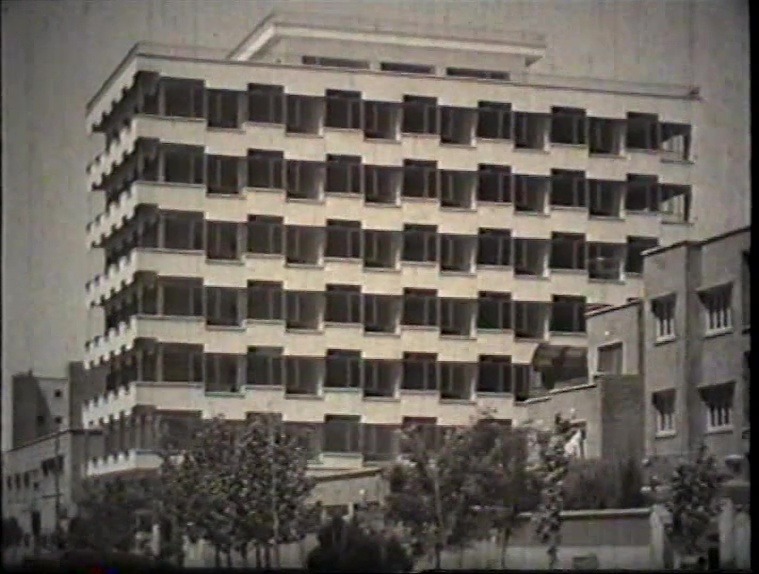
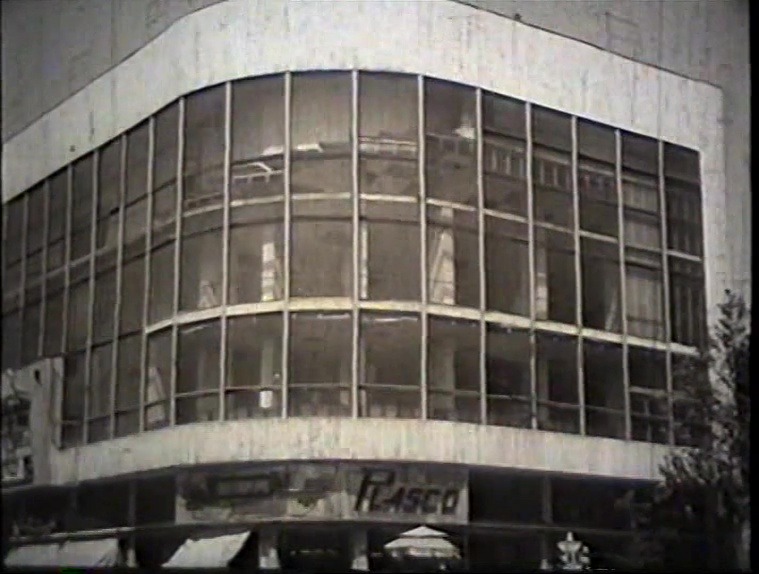
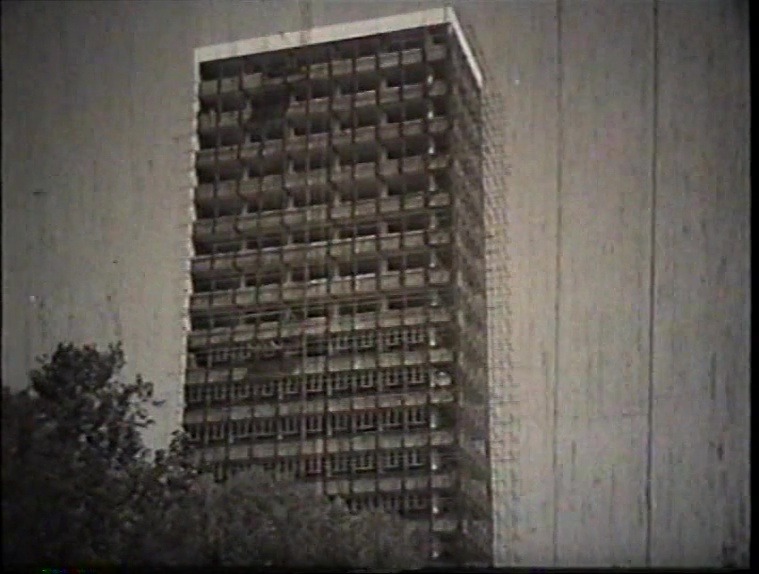
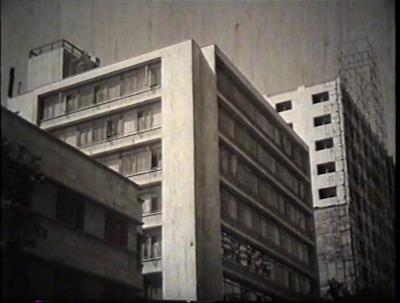
Tehran’s newly built modernist buildings shown during the title sequence of Reghabat dar Shahr [Rivalry in the City] (Uncredited, 1963)

This is the censored and re-edited version of Jonob-e Shahr [South of the City] (Farrokh Ghaffari, 1958)

Monday, 24 January 2022

Monogramming#2

Monogram Pictures, 1942 | 1725 Fleming Street in East Hollywood

From an ad campaign, May 1942:


MONOGRAM'S 10th  ANNIVERSARY

Promise  vs.  Performance 

A  promise  is  a  sacred  obligation.  Monogram  Pictures  will  not  tolerate  a  promise  unfulfilled. 

A  promise  is  only  as  good  as  the  one  who  makes  it.  As men  are  judged  by  what  they  have  done  in  the  past,  so  we  of  Monogram  Pictures,  with  a  background  of  promises  fulfilled, sincerely  ask  for  your  support  in  what  we  are  offering  for  the season  1942-43. 

We  are  young  in  years,  but  old  in  showmanship.  We  have  approached  the  coming  year  with  a  determination  to  make  this MONOGRAM'S  GREATEST  YEAR! 

Thursday, 6 January 2022

Never on Sunday: Under Your Skin (Mikko Niskanen, 1966)

Under Your Skin

NEVER ON SUNDAY is a series of screenings of rare classics, archive masterpieces, obscure delights and forgotten gems taking place the last Sunday of each month at Close-Up Cinema in east London. The first screening, on January 30, is dedicated to Mikko Niskanen's Under Your Skin. Tickets here.


Käpy selän alla [Under Your Skin]

Dir: Mikko Niskanen, 1966, 99 min, 35mm

Directed by Mikko Niskanen, an indispensable figure of Finnish new cinema of the 1960s, Under Your Skin is one of the most significant films in the history of Finnish cinema which, in the spirit of New Wave, embraces a whole new generation of Finns dreaming of "a universal sense of responsibility." (Peter von Bagh). The tender and real depiction of this new politically-conscious generation, as well as fresh cinematic ideas employed, were warmly welcomed by both the Finnish audiences (making the film the second box office hit of 1966) and the critics, the latter leading to the film winning six Jussi awards, the Finnish equivalent of the Oscar.

Thursday, 23 December 2021

Sixtynine (Jörn Donner, 1969)

Sixtynine (1969)

As a part of tribute to Jörn Donner, Sixtynine plays (on 35mm) at London's Closeup Film Centre on January 14, 2021. - EK


When a working woman learns of her part-time hockey referee husband's infidelity, she takes her gynaecologist's advice, to "take a lover", seriously and ends up sleeping with him.  

This sex comedy, Jörn Donner's second Finnish feature after four films made in Sweden, was deemed too scandalous even for Finnish society in the late 1960s. It continues some of the themes the director had previously explored in Black on White (1968) and with its fluent use of fast cutting and motion, fantasy sequences and documentary style camerawork, it could be seen as Finland's response to the Swinging Sixties, as the decade was coming to a close.  

As well the title's allusion to the year, Donner (who himself appears playing the role of the dispassionate gynaecologist) says the film is called Sixtynine because the relationships in the film have turned upside-down – despite some Finns feeling near certain that some "immoral sexual acts" were meant to be promoted by the film. 

Monday, 13 December 2021

Monogramming


A survey of the production line (shooting and editing stages) of Monogram studio as in July 1952. The "star directors" in the stable for summer productions are William Beaudine, Lesley Selander, Kurt Neumann, Lew Landers and also less appealing Thomas Carr and Ray Nazzarro.

Click to enlarge.

Wednesday, 24 November 2021

La revolució oblidada. Cinema iranià anterior a 1979


Programme curated for Filmoteca de Catalunya (December 2021). — EK 

[Short introduction in Catalan]


La revolució del 1979 va canviar el destí i el rostre de l’Iran. Com la majoria de les revolucions, també va suprimir el passat i les seves imatges, i amb això un dels cinemes més innovadors d’aquella època. Aquest programa mostra algunes de les pel·lícules clau de la revolució cinematogràfica més progressista, interrompuda per una altra de social per la qual el país va acabar sent conegut.

Aquesta retrospectiva de cinema iranià anterior al 1979 fa reviure pel·lícules prohibides, perdudes o simplement oblidades. Obres mestres de la Nova Onada Iraniana que s’estrenen ara, acabades de restaurar, al nostre país.

Sunday, 21 November 2021

I Wake Up Screaming (Bruce Humberstone, 1941)


I WAKE UP SCREAMING (1941)

Dir: Bruce Humberstone


Originally titled Hot Spot and even released in some territories as such, this is an indispensable work in the development of film noir. Focusing on the psychological complexions and sexual obsessions of its characters, the film's expansion of noir themes as well as its use of chiaroscuro lighting are pioneering, even if the "wrong man" story doesn't always abide by the rules it has defined and ventures into other, lighter territory.

The murder of rising star Vicky Lynn (Carole Landis) is announced at the beginning of the film and through a series of flashbacks, narrated by her sister Jill (Betty Grable) and the suspects, we learn about how the capricious Frankie Christopher (Victor Mature) has turned Vicky from a waitress into a celebrity. During the investigation we are also introduced to a psychotic detective, Ed Cornell (Laird Cregar), who is already convinced of Frankie's guilt and determined to send him to the "hot chair". The framed Frankie and Jill, now in love, embark on their own investigation while Cornell is on their tail.

Tuesday, 9 November 2021

Conversation with Paul Haggis

Paul Haggis (left) in Bologna

My conversation with writer and director Paul Haggis, recorded in Bologna on July 27,  2021.

The Cinema of George Stevens: A Dialogue Between Imogen Sara Smith & Ehsan Khoshbakht

George Stevens (standing, right) on the set of Giant

Video of a dialogue between Imogen Sara Smith and I about the cinema of George Stevens, recorded in Bologna, July 2021. — Ehsan Khoshbakht

Sunday, 7 November 2021

Esmail Koushan: The Storm of Life (by Abbas Baharloo)

Esmail Koushan

When serving as the editor-in-chief of the now defunct Underline arts quarterly, I celebrated the centenary of Iranian film director-producer by commissioning two pieces on him. This is the second essay (the first one, by Nima Hassani-Nasab, is already available here), written by the untiring historian of Iranian cinema Abbas Baharloo. I'm publishing it here for the first time. — EK


Esmail Koushan: The Storm of Life

By Abbas Baharloo

A portrait of Esamil Koushan, one of the fathering figures of Iranian cinema


Esmail Koushan, producer, director, screenwriter, cinema owner and founder of the largest film studio in Iran, has been described as both ‘the father of Iranian cinema’ and ‘the bad guy of Iranian cinema’.

From the very beginning, Koushan was determined to be a pioneer. He was responsible for the first foreign film to be dubbed into Persian; he founded the first film studio in Iran, Mitra Film, after cinema had experienced a fallow period (1937-47) following the art form’s initial development there; and was the producer of the first Iranian talkie to be made in Iran, The Storm of Life (1948). He made possible the production of the first episodic film in Iran (The Spring Variety, 1949); he initiated the making of the first black and white CinemaScope film (Accusation, directed by Shapur Yasami, 1956), colour CinemaScope film (The Runaway Bride, which he directed himself, 1958), and the first films co-produced with France (Ebram in Paris, directed by himself, 1964), Turkey (Divine Justice, 1969), and West Germany (The Sleeping Lion, directed by Esmail’s brother, Mahmoud Koushan, 1976). He also initiated the publication of one of the first Iranian film magazines (Alam-e Honar or ‘The World of Art’, 1951).

Divine Justice (1969)

Esmail Harir-Forush (his surname meant ‘the silk merchant’), who following the example of his uncle changed his surname to Koushan, was born in Tehran in 1917. He passed away in the same city on 5th July 1983. He began his studies at the Dar ol-Fonun School, and at the end of autumn 1937, at a time when the reign of Reza Shah had led to a contraction of commercial relations with Britain and an increase in contacts with Germany, he moved to the latter country to continue his education, studying economics in Berlin. At a time when he benefited from no financial assistance, he made the acquaintance of Bahram Keykhosro Shahrokh, son of a prominent Iranian politician and a newsreader for Radio Berlin.

Thursday, 14 October 2021

Filmfarsi on DVD!

Filmfarsi

 
Filmfarsi will be released on DVD in North America (via Grasshopper Film) on November 9, 2021. Pre-order here.

The design is by F Ron Miller.

Wednesday, 29 September 2021

The Curious and the Downcast: An Interview with Kamran Shirdel

Kamran Shirdel at the exhibition. Photo (c) Houshang Golmakani

The Curious and the Downcast: An Interview with Kamran Shirdel

By Houshang Golmakani


An interview with the distinguished Iranian filmmaker, photographer, and writer about his latest exhibition of films and photographs taken during the days of the Iranian Revolution. I commissioned this for a winter 2019 issue of Underline magazine but by the time this was translated and edited, the Underline project was abruptly folded. I publish it here for the first time. — EK


As we approach the 40th anniversary of the revolution that saw the monarch of Iran overthrown and replaced with an Islamic republic, renowned documentary filmmaker and photographer Kamran Shirdel is now exhibiting his photographs and raw, unedited footage of the historical event for the first time at a gallery in Tehran. Born in 1939, Shirdel originally studied architecture at the University of Rome before going on to study film at the Centro Sperimentale di Cinematografia. Upon his return to Iran in 1964, he produced a number of documentaries on Iranian social issues in the space of just a few years, the most famous of which include Women's Prison, Women's Quarter, Tehran Is the Capital of Iran, and his satirical masterpiece The Night It Rained. Due to their controversial subjects, all of these early documentaries were banned at the time of their release and Shirdel had several encounters with the Shah's secret police force SAVAK as a result. With the exception of his first and only feature-length film, The Morning of the Fourth Day (1972), Shirdel was forced to pursue industrial documentary filmmaking in the years that followed. 1978 saw a rise in strikes and social unrest that fuelled the fires of an impending revolution: the event that Shirdel had been waiting for ever since his return to Iran. Armed with a video camera and a camera, Shirdel took to the streets of Tehran, tirelessly documenting every development throughout the course of the revolution.

40 years later, and for the first time since they were taken, Shirdel's photographs and footage from those days are now being exhibited at the Nabshi Centre in Tehran from 30 November 2018 to 25 January 2019.  Shirdel, who was 39 years old at the time of the revolution, will turn 80 later this year. Despite his age and a spinal condition that requires him to use a walking stick, Shirdel still attends the exhibition almost every day in order to see the effects of his work first-hand. The exhibition itself is relatively large, covering two floors, with mostly large-scale photographs displayed on the walls and 40-year-old, antique television sets showing 8mm footage on repeat. Unfortunately, Shirdel's 16mm footage was confiscated in the days following the revolution and no trace of them has been seen since then. 

Wednesday, 22 September 2021

Sight & Sound's 100 'Hidden Heroes' of Cinema: Lily Amir-Arjomand

Lily Amir-Arjomand

From Sight & Sound magazine, Summer 2021, Vol. 31, Issue 6, dedicated to unsung heroes of cinema. This was my contribution, trying to go beyond the familiar names and professions one hears on a film set. — EK


Lily Amir-Arjomand (b. 1938)

One of the key architects of the new Iranian cinema, Lily Amir-Arjomand was most likely unfamiliar with even the most basic film terminology. But no matter when she had one thing that no one else in Iran has possessed before or since: trust in the filmmaker.

Emerging from a privileged background, this former classmate of the Queen of Iran was a technocrat with imagination. In 1964 she founded a library for children. Four years later Kanoon had become an impeccably streamlined production house for first-rate cultural goods (including films) aimed at children, with centres spread all over the country. And everything was free.

Saturday, 11 September 2021

Alias Nick Beal (John Farrow, 1949)

Alias Nick Beal, publicity still

Written for the catalogue of Il Cinema Ritrovato 2021. -- EK


In 1948 director John Farrow began a close, decade-long collaboration with writer Jonathan Latimer that resulted in ten films, including one marvel (The Big Clock), quite a few greats (Night Has a Thousand Eyes among them), and some obscurities. The intensely engaging Alias Nick Beal, their fourth collaboration, is a dark, claustrophobic variation on the story of Faust (Mindret Lord's original story was titled Dr. Joe Faust) in keeping with the increasingly relevant "political corruption" cycle of the late 1940s (the Oscar for Best Film in 1949 went to All the King's Men). Thomas Mitchell plays Joseph Foster, an ambitious district attorney who meets a shady character who offers to help him in his rise up the political ladder. But there's a price to be paid, especially when one is dealing with the Devil, alias Nick Beal.

Wednesday, 1 September 2021

Duke Ellington in Isfahan

Duke Ellington in Isfahan 

Director: Ehsan Khoshbakht

UK, 12', 2018/2021, colour/b&w

World premiere: Telluride Film Festival 2021


This short documentary by the Iranian filmmaker, writer and archivist Ehsan Khoshbakht tells the story of Duke Ellington's concert tour of the Middle East in 1963 and the development of one of the most beautiful jazz standards.  

The legendary composer and bandleader was seen as the ideal cultural ambassador for the United States at the height of the Cold War, when President Eisenhower's desired perception of the US as a moral force for good in the world was being undermined by an awareness of its treatment of African-Americans. 

Arriving in Iran with his band, Ellington was inspired by the historical city of Isfahan and especially its architectural riches. It would give its name to one of the pianist's most enduring compositions, and the tour as a whole helped to shape a Grammy Award-winning album, Far East Suite, which showed how much Ellington had absorbed from the sounds of his travels. 

Using archival images and video footage, and with added insight from broadcaster and jazz historian Alyn Shipton, Duke Ellington in Isfahan shines a light on a largely forgotten episode in jazz history and political history, and provides a clearer sense of the ways in which Ellington's music was affected by, and reflects, his vision of the East.

Wednesday, 18 August 2021

The Lady of the Harem (Raoul Walsh, 1926)

Hollywood Orientalism involving Iran#1: The Lady of the Harem

A lost silent from 1926, produced by Paramount, directed by Raoul Walsh.

"Jesse L. Lasky announced that The Lady of the Harem has been selected as the title for the Paramount picture which, under the working title of "The Golden Journey," Raoul Walsh has just made from James Elroy Flecker's play Hassan. The new title is considered exceptionally appropriate, as the story deals largely with the lavish harem of the Caliph of Khorasan, Persia, during the twelfth century. 

"Featuring Ernest Torrence, Greta Nissen, William Collier, Jr., and Louise Fazenda," said Mr. Laskey, "The Lady of the Harem will be one of the most colorful and sensational pictures ever produced by this company. Mr. Walsh, who directed The Wanderer and The Thief of Bagdad has filled  this new spectacle with all the colorful atmosphere of the East and I am confident that this production will receive an even  greater reception than was accorded The Wanderer." [From Moving Pictures, 1926]

Tuesday, 3 August 2021

Il Cinema Ritrovato 2021: Favourites & Discoveries


Il Cinema Ritrovato 2021 ended last week, on an uplifting note. More than 400 films and other projectionable audiovisual curiosities were shown and seen. While still in the post-festival haze, I sought the insight of some of the festival attendees on what they thought to be the essential — what was liked and cherished most, what was discovered and became a revelation.

I posed two questions on colleagues and friends who attended the festival in person: What was your absolute favourite film this year and which film turned out to be a major discovery or rediscovery at the festival. They were gracious enough to send me their picks which you can read here in alphabetical order. (Please feel free to add your favourites in the comment section of this post.) 


Some contributors have sent along some notes which I wanted to share with you. They come at the bottom of the post, marked by * (star)

You can also view this list on Letterboxd where it has been nicely compiled and illustrated by Jon M.